Lightning — History & Facts
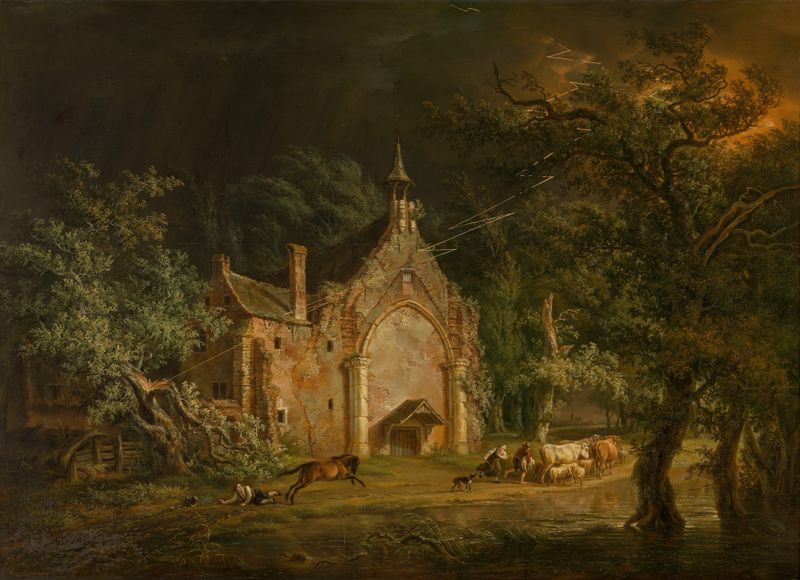
What if beauty was never meant to be finished? In Lightning, the viewer is invited to explore the fleeting nature of existence, where each brushstroke captures a moment poised between stillness and upheaval. Focus on the swirling clouds that dominate the canvas, painted with an array of grays and whites that dance at the edges of tumult. Notice how the flash of light cuts through the darkness, illuminating the chaos with a stark brilliance that draws your eye to the center. Van Assche’s masterful technique employs contrasting tones to create a sense of depth, while the jagged lines of the lightning evoke the raw, electric energy of nature itself. Delve deeper, and you’ll find a juxtaposition of serenity and chaos.
The calmness of the landscape below starkly contrasts with the violent energy above, suggesting a narrative of the sublime—a reminder of humanity's place within the larger forces of nature. This interplay conveys both awe and trepidation, capturing the paradox of beauty intertwined with destruction, urging us to confront the transient nature of our own experiences. In 1806, Henri van Assche was at a pivotal point in his career, grappling with the burgeoning Romantic movement that sought to express the sublime in art. Living in Belgium during a time of political upheaval and artistic transformation, he was influenced by the changing dynamics of European art and culture.
This piece reflects not only his mastery of technique but also a deep philosophical inquiry into the relationship between humanity and the natural world.