L’Obélisque — History & Facts
What if beauty was never meant to be finished? In the heart of L’Obélisque, we confront a sculptural form of reverence that invites us into a world of mystery and revelation. Look to the center, where the towering obelisk, carved from stone and draped with soft shadows, commands the viewer's gaze. Its surfaces glisten with a rich patina, while warm hues of ochre contrast against cool silvers. Notice how the intricate patterns and hieroglyphs whisper stories of ancient civilizations, hinting at forgotten meanings and the passage of time.
The artist’s delicate brushwork transforms the hard edges of the monument into something almost organic, blurring the lines between creation and decay. Deeper still, the juxtaposition of light and shadow draws our attention to the figures flanking the obelisk, embodying the struggle between man and nature. They are both reverent and fragile, revealing their vulnerability in the presence of the monument's grandeur. With every brushstroke, a dialogue unfolds — a conversation about memory, history, and the ephemeral nature of existence.
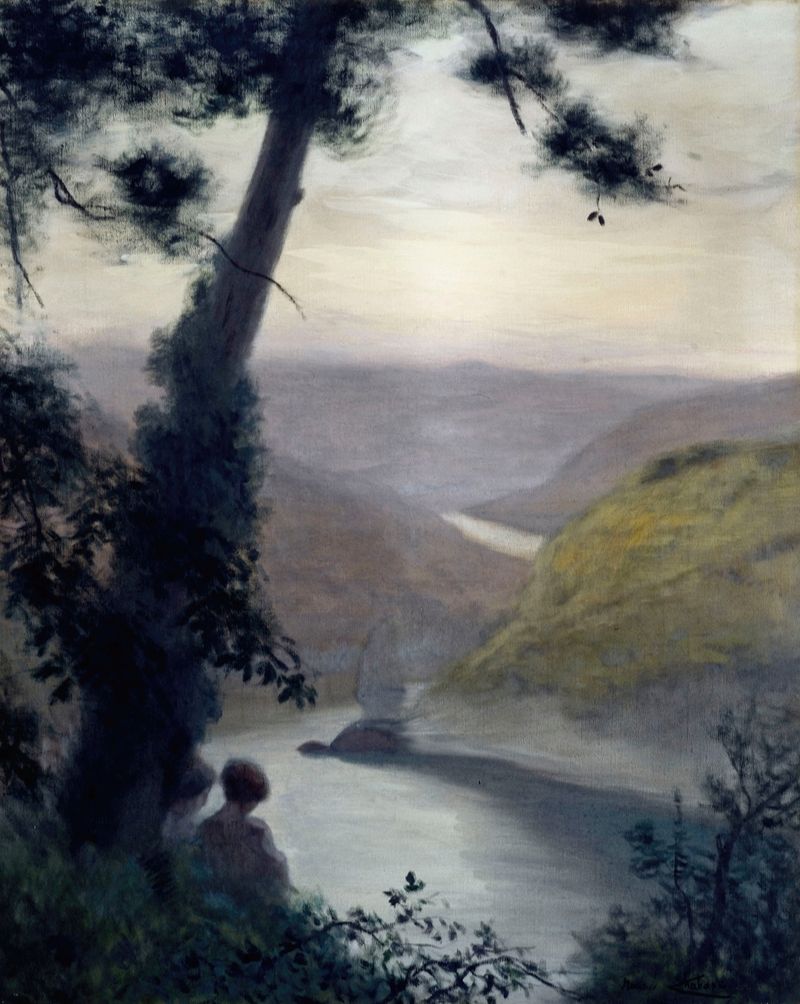
Here, beauty exists not as a final destination but as a continuous journey, echoing the transient moments of life. Created in 1898 during a period of artistic exploration, the piece reflects Maurice Chabas's fascination with symbolism and romanticism. Living in France, he grappled with a rapidly changing society, where traditional values were being challenged. As the art world leaned towards modernity, Chabas sought to express the timeless allure of the past, capturing a moment that urges contemplation amidst life's relentless progression.