
Lone Bay — History & Facts
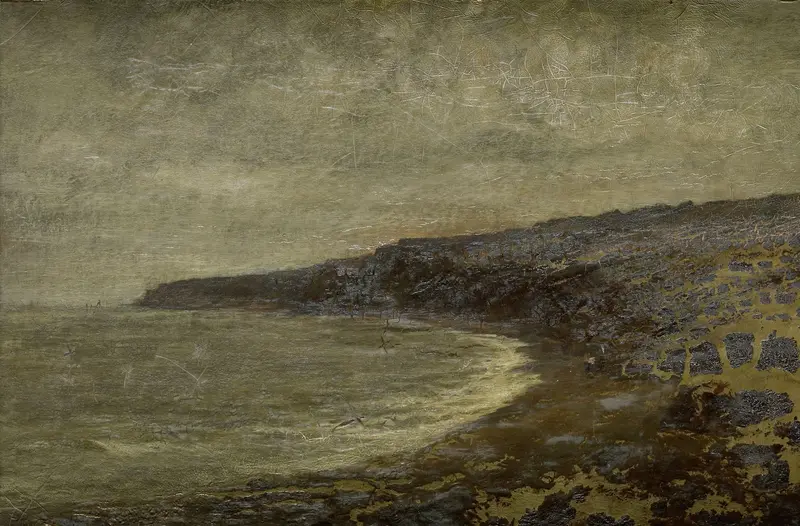
What first draws the eye in Lone Bay is the hush that seems to settle over the entire scene, as if the world itself is holding its breath. The painter, Arthur Hawksley, leads us along a gentle curve of sand and rock, where the shoreline dissolves into a muted, silvery sea. The palette is all restraint—greys, ochres, and browns—so that every highlight on the water’s edge feels deliberate, almost precious.
The sky, veiled and streaked, presses low, blurring the boundary between land and air, and the distant headland anchors the emptiness with a quiet weight. There are no figures to break the spell; instead, the viewer is left to wander, drawn by the subtle play of light and texture that suggests both solitude and possibility. Painted in 1886, this work belongs to a moment when landscape painting was shifting from grand, heroic vistas to quieter, more introspective views of nature. In the late nineteenth century, artists across Europe were turning their attention to the overlooked corners of the coast and countryside, often seeking to capture atmosphere and mood rather than spectacle.
Little is recorded about the journey of this particular painting, now housed in the Rijksmuseum, but its very obscurity is part of its story: it stands as a testament to the countless artists who found meaning in the everyday, and to the viewers who continue to find themselves reflected in such silent places. The longer you look, the more the painting seems to reveal—each brushstroke another invitation to linger.
More Artworks by Arthur Hawksley
More Landscape Art

The Starry Night
Vincent van Gogh

View of Delft
Johannes Vermeer

Water Lilies
Claude Monet

The Grand Canal, Venice, looking north-west from the Ca' Corner to the Ca' Contarini degli Scrigni, with the campanile of Santa Maria della Carità
Canaletto

Windsor Castle
Canaletto

The Grand Canal looking North-East from the Palazzo Dolfin-Manin to the Rialto Bridge
Canaletto