Looking towards Ryde, Isle of Wight — History & Facts
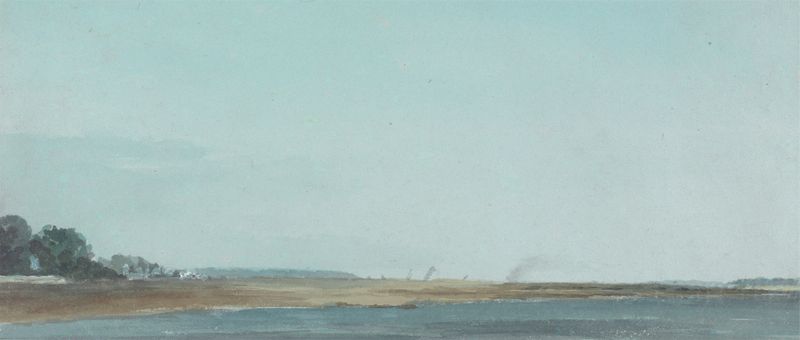
Can beauty exist without sorrow? In Looking towards Ryde, Isle of Wight, the artist captures a serene moment that hints at the subtleties of rebirth woven through the landscape. Look to the left where lush greens cascade down to the shoreline, a testament to nature's resilience. The horizon glimmers in soft blues and grays, where the sky meets the sea, inviting the viewer into a peaceful embrace. The gentle brushstrokes create a harmonious dialogue between land and water, each element infused with a sense of tranquility, while the contrast of light and shadow brings depth and dimension to the scene. As you explore further, notice the delicate interplay of light dappling the waves, reflecting hope in the midst of monotony.
The foreground is punctuated by the distant silhouette of Ryde, embodying a juxtaposition of man-made structures against the untamed natural beauty. This contrast evokes a sense of longing for connection, reminding us that even in calm, there are undercurrents of turmoil, like the ebb and flow of tides that carry whispers of change. In 1832, Thomas Lindsay painted this piece during a time of personal reflection, grappling with the art movements evolving in Europe. The Romantic era was in full bloom, celebrating nature’s beauty and humanity's emotional response to it.
As he stood before the Isle of Wight, Lindsay was not only capturing a picturesque view but also resonating with the broader quest for identity and rebirth that characterized the artistic landscape of his time.