L’orage — History & Facts
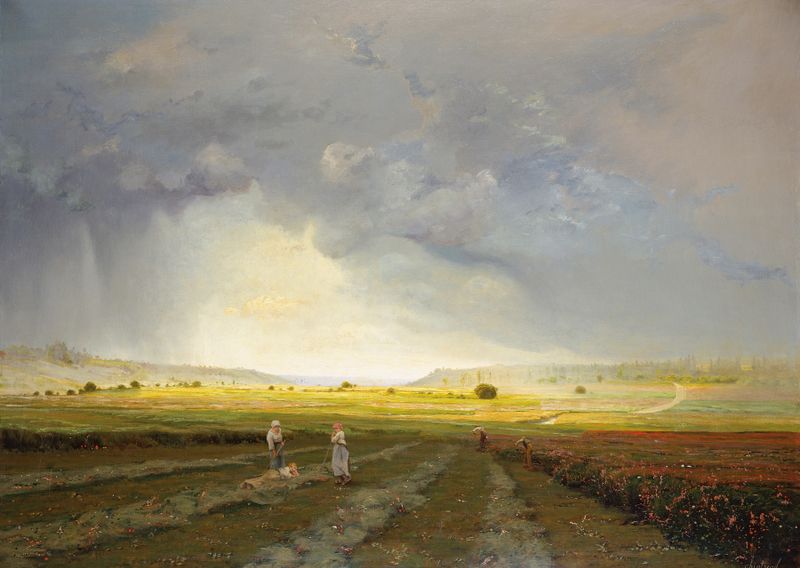
In L’orage, fragility floats like a whisper above the landscape, capturing a fleeting moment between tempest and tranquility. Look to the left at the dark, swirling clouds, heavy with the promise of rain. Notice how they dominate the sky, contrasting sharply with the luminous patches of light breaking through, illuminating the landscape below. The palette is rich, with deep blues and greens that evoke both foreboding and vitality.
Chintreuil’s brushwork is deft, creating a sense of movement that pulls the eye across the canvas, as if one can feel the impending storm approaching, yet still bask in the lingering sunlight. Beneath the surface, subtle contrasts emerge. The stability of the landscape—a craggy hill adorned with resilient trees—stands in stark opposition to the chaos of the sky above. This tension speaks to the fragility of existence, where nature's beauty is often intertwined with its volatility.
The play of light and shadow mirrors the duality of hope and despair, inviting the viewer to reflect on the balance between serenity and disruption in life. Painted in 1852, this work emerged during a period of transition for Chintreuil, marked by his exploration of nature’s emotive power. While living in France, he was influenced by the rising Romantic movement, which sought to express the sublime through the portrayal of emotional landscapes. Amidst a world on the brink of modernity, L’orage captures the timeless cycle of nature’s fury and grace, a reminder of our own fragile place within it.