Man + Air + Space — History & Facts
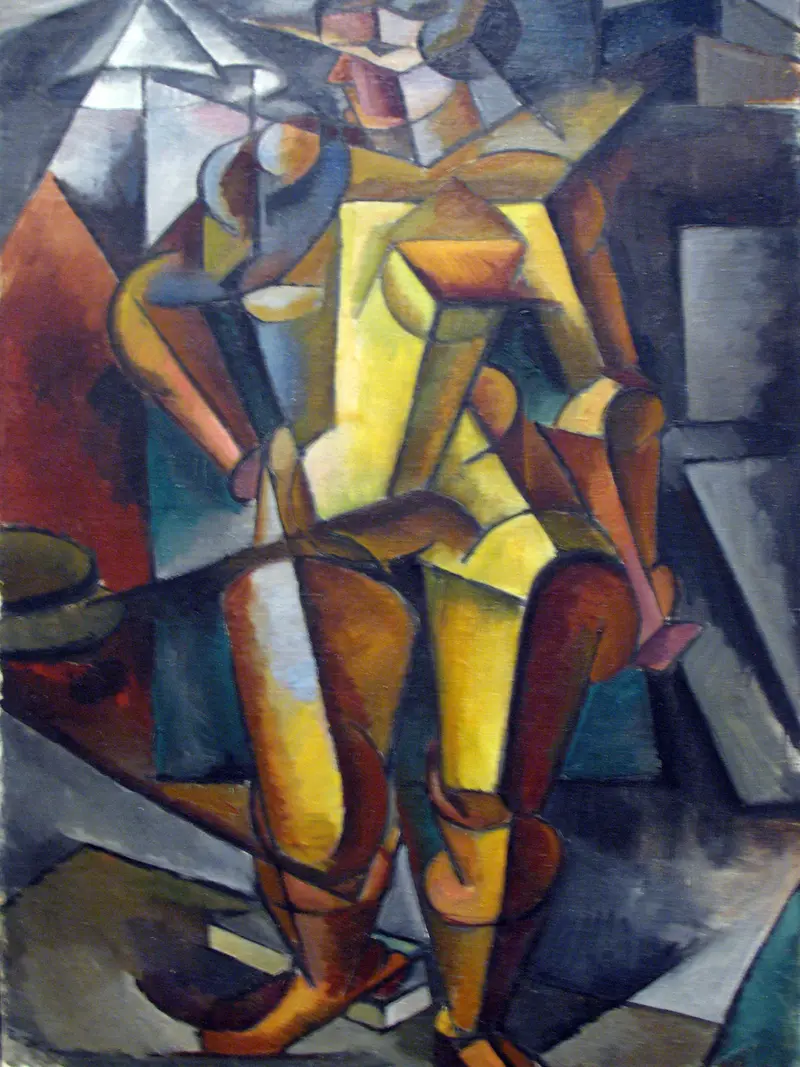
Man + Air + Space is an oil on canvas painting created by Lyubov Popova in 1913. The work dates from an early and experimental phase in Popova’s career, during a period when she was engaging with the emerging currents of Russian Futurism and Cubo-Futurism. It is an example of Popova’s interest in the synthesis of figure and environment through geometric abstraction. The composition features a human figure rendered in a series of intersecting planes, angular shapes, and faceted forms.
The figure is constructed using a palette dominated by warm ochres, reds, and browns, contrasted with cooler blues, greys, and whites. The background and surrounding space dissolve into a complex arrangement of geometric volumes, suggesting both movement and the permeation of the figure by its environment. The brushwork is precise, with sharp delineations between color fields, and the lighting is implied through the use of tonal contrast rather than naturalistic modeling. This painting belongs to the broader context of Russian avant-garde art in the early 1910s, when artists such as Lyubov Popova were exploring new visual languages influenced by French Cubism and Italian Futurism.
Works from this period often sought to convey the dynamism of modern life and the relationship between human beings and their technological surroundings. Man + Air + Space belongs to the Russian Museum in Saint Petersburg.