Marseilles Harbour with a Lighthouse — History & Facts
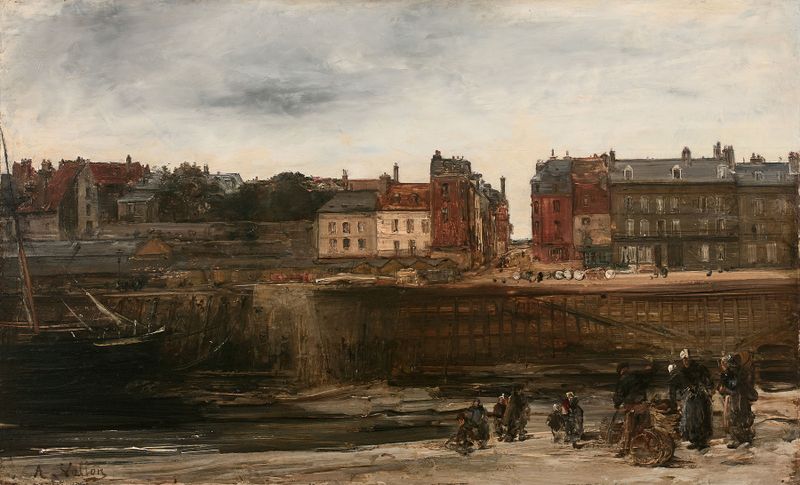
What if silence could speak through light? The interplay of shadows and illumination in Marseilles Harbour with a Lighthouse invites us to listen closely to what remains unvoiced. Look to the calm waters at the foreground, where gentle ripples reflect the soft hues of the evening sky. The lighthouse stands resolute to the right, its beam piercing the dusk, guiding both ships and thoughts through the obscured horizon. Notice how the warm oranges and deep blues create a contrast that evokes both tranquility and the underlying turbulence of life at sea.
The meticulous brushwork conveys movement, yet the scene holds a stillness, suggesting a moment frozen in time. Amidst this calm lies emotional tension: the lighthouse, a steadfast guardian, symbolizes hope amidst uncertainty, while the distant boats evoke a sense of adventure and the unknown. The subtle blending of colors hints at an impending change, as if the revolution of day into night echoes a shift in society itself. In this moment, the harbor becomes a metaphor for transition, where remnants of the old world fade into the possibilities of the new. Antoine Vollon painted this work around 1887, a time when France was experiencing social and political upheaval.
Living in Paris, Vollon was closely connected to the Impressionist movement, yet he often drew inspiration from realism. This painting reflects not only his fascination with light and atmosphere but also the broader context of a world on the brink of transformation, as industrialization and changing social landscapes reshaped the notion of life's journey.