Meleager and Atalanta and the Hunt of the Calydonian Boar — History & Facts
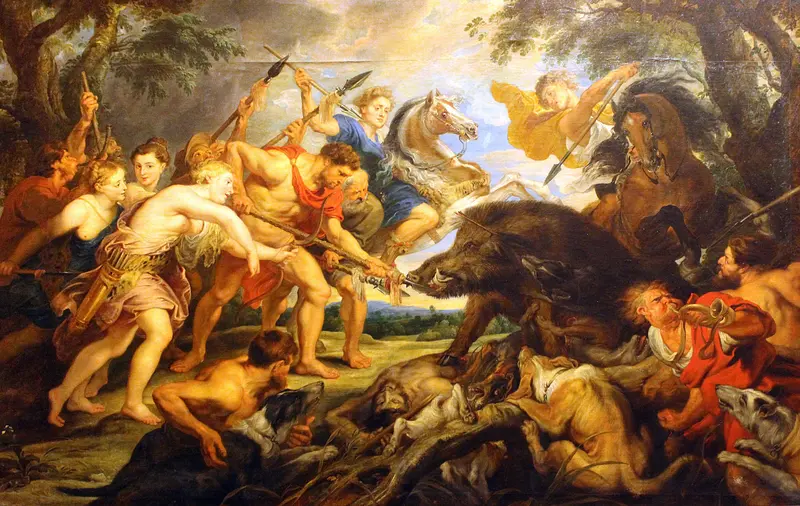
Few stories in ancient myth have inspired as many brushstrokes as the Calydonian Boar Hunt, but Peter Paul Rubens’s Meleager and Atalanta and the Hunt of the Calydonian Boar stands out for its sheer dynamism and scale. Painted in 1618, this work is one of several versions Rubens created on the subject, each time reimagining the legendary contest that pitted mortals against a monstrous beast. The painting was likely intended for a learned collector who prized both mythological erudition and the bravura of contemporary Flemish painting.
Rubens’s fascination with the tale is echoed by his contemporaries, but few matched his ability to fuse classical drama with the physicality of the hunt. At the moment Rubens selects, the action is at its height: Meleager, spear poised, and Atalanta, bow drawn, confront the rampaging boar that has ravaged Calydon. Atalanta’s arrow, already loosed, finds its mark—a nod to her unique role as both heroine and outsider among the male hunters. The swirling composition draws the eye from the muscular figures of the hunters to the writhing form of the boar, whose bristling hide and gaping maw dominate the foreground.
Dogs leap and snarl, their bodies echoing the chaos of battle, while the distant landscape recedes into a stormy sky. Compared to Frans Snyders’s more zoological depictions of the hunt, Rubens’s version is a tempest of human and animal energy, charged with the tension of myth and rivalry. The painting’s early history is not fully documented, but it is characteristic of the grand mythological canvases Rubens produced for princely patrons and collectors in Antwerp and beyond. Over the centuries, works like this have moved through royal collections and private hands, sometimes misattributed or paired with companion pieces on related themes.
Today, Meleager and Atalanta and the Hunt of the Calydonian Boar is recognized as a testament to Rubens’s mature style, where myth, movement, and the human form collide. Its place in the artist’s career marks a period when he led one of Europe’s busiest workshops, training a generation of painters who would carry the exuberance of the Baroque across the continent.
More Artworks by Peter Paul Rubens

The Coronation of Henri IV
Peter Paul Rubens

Portrait de Marie de Médicis
Peter Paul Rubens

Apollo and Daphne
Peter Paul Rubens

Anne of Austria, Queen of France
Peter Paul Rubens

Bacchus and Ariadne
Peter Paul Rubens

Christ on the Cross with Maria, Mary Magdalene and St John
Peter Paul Rubens

Equestrian portrait of Charles Colonna, Duke of Marsi
Peter Paul Rubens

Hippomenes and Atalanta
Peter Paul Rubens

Perseus and Andromeda
Peter Paul Rubens
Pentecost
Peter Paul Rubens