Mühle am Gebirgsbach — History & Facts
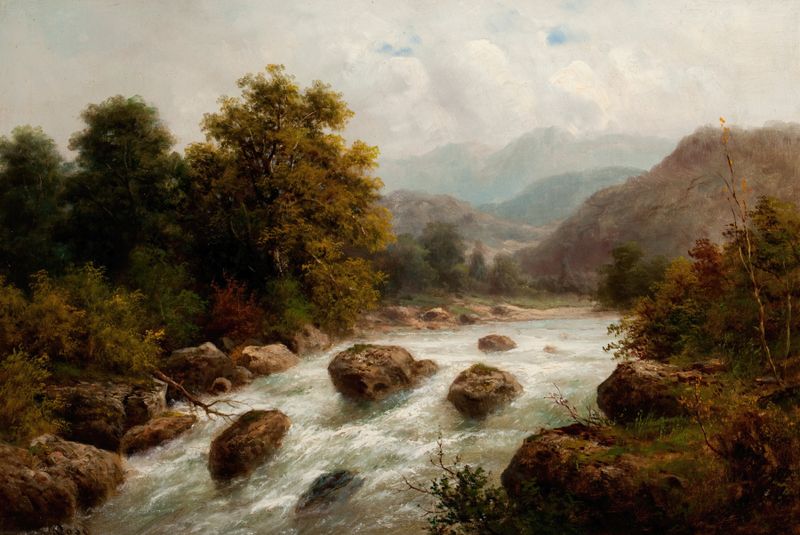
Can paint confess what words never could? In the muted tones of solitude, a landscape unfolds that speaks volumes, capturing the essence of loneliness in nature's embrace. Look to the left at the rugged, moss-covered stones that frame the foreground, their textures rendered with meticulous attention. The gentle flow of the stream draws the eye toward the mill nestled against the backdrop of distant mountains, its structure seemingly swallowed by the surrounding wilderness. Observe how the soft, diffused light filters through the trees, casting dappled shadows that dance upon the water's surface, inviting both peace and introspection. This scene contrasts the vibrant life of the water with the stillness of the mill, which stands as a testament to human endeavor yet feels isolated in its quietude.
The juxtaposition of the rushing stream and the stationary structure evokes a palpable tension—between movement and stasis, connection and separation. Notice how the slight bend of the stream mirrors the curve of loneliness, suggesting that while nature flows with life, human creations often anchor us to solitude. Julius Rose painted this piece during a time when the art world was navigating through the currents of change, possibly in the late 19th or early 20th century. Little is known about his life, but it is believed he worked predominantly in Germany, where landscapes often reflected deeper emotional states.
This artwork encapsulates not only the natural beauty of his surroundings but also the complex emotions that can arise from solitude, a theme that resonates deeply with the viewer.