Mountain stream, Kaikoura — History & Facts
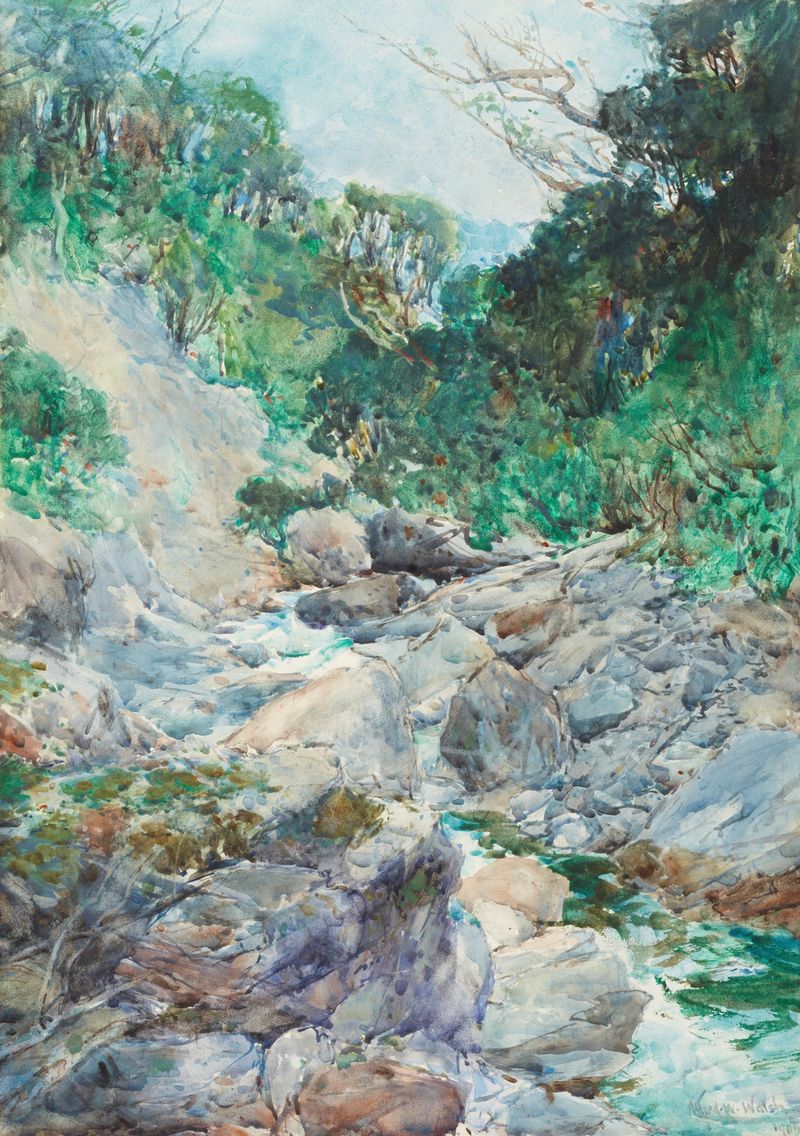
Where does light end, and longing begin? In the delicate interplay of nature’s elements, we often find traces of our own grief, echoing softly like footsteps along a winding path. Look to the left at the vibrant hues of emerald and aquamarine that dance across the flowing waters of the stream. The brushwork is both fluid and precise, capturing the way light refracts against the water's surface, creating shimmering patterns that seem to pulse with life. Notice how the sunlight filters through the canopy above, casting dappled shadows that play upon the rocky banks.
Each stroke reveals the artist's deft hand, uniting the raw energy of the water with the stillness of the surrounding landscape. As you delve deeper into the scene, subtle contrasts emerge—a juxtaposition of movement and stillness, joy and sorrow. The vibrant greens evoke a sense of vitality, yet the stream’s gentle flow hints at the passage of time, the transient nature of beauty. Each jagged stone bears witness to enduring struggles, while the leaves whisper of memories lost to the currents of life.
Here, nature becomes a mirror reflecting the complexities of human emotion, a reminder that grief can be as serene as a mountain stream. Alfred Walsh painted this scene in 1910, during a period marked by personal transitions and a growing recognition of New Zealand’s unique landscapes in the art world. As he captured the essence of Kaikoura’s natural beauty, he was also navigating the profound changes within himself and his surroundings, channeling these experiences into his work. At this time, the movement toward a distinctly national identity in art was gaining momentum, allowing Walsh to express both the external and internal landscapes of his world.