
Officers and Other Civic Guardsmen of District XVIII in Amsterdam, under the Command of Captain Albert Dircksz Bas and Lieutenant Lucas Pietersz Conijn — History & Facts
In a world where innocence often becomes a casualty of time, how do we preserve the essence of those who stand guard over our lives and liberties? Look to the center of the canvas, where the commanding figures of Captain Albert Dircksz Bas and Lieutenant Lucas Pietersz Conijn assert their presence. Both men, depicted in richly detailed uniforms, draw the eye with their confident postures and piercing gazes. Notice how the light cascades over their faces, highlighting their resolute expressions.
Surrounding them, the other civic guardsmen create a dynamic composition that balances authority with camaraderie, each figure uniquely captured in their moment of duty. Yet, beneath the veneer of civic pride lies a palpable tension. The varying poses and expressions evoke a sense of preparation for conflict, a reminder of the innocence that these guardsmen vow to protect. The interplay of light and shadow on their faces suggests the duality of their roles—both enforcers and defenders of the community.
The background, a muted blend of earthy tones, contrasts starkly with the vibrant colors of their uniforms, symbolizing the quiet chaos of life unfolding beyond their watchful gaze. In 1645, Flinck painted this work during a time of political tension in the Netherlands, as the country faced both internal strife and external threats. Rising in the ranks of the Dutch Golden Age, he was influenced by the stylistic innovations of Rembrandt, even as he sought to establish his own artistic identity. This painting reflects not only the societal values of the time but also Flinck’s desire to immortalize the guardians of innocence in a moment of poised readiness.
More Artworks by Govert Flinck
Browse all →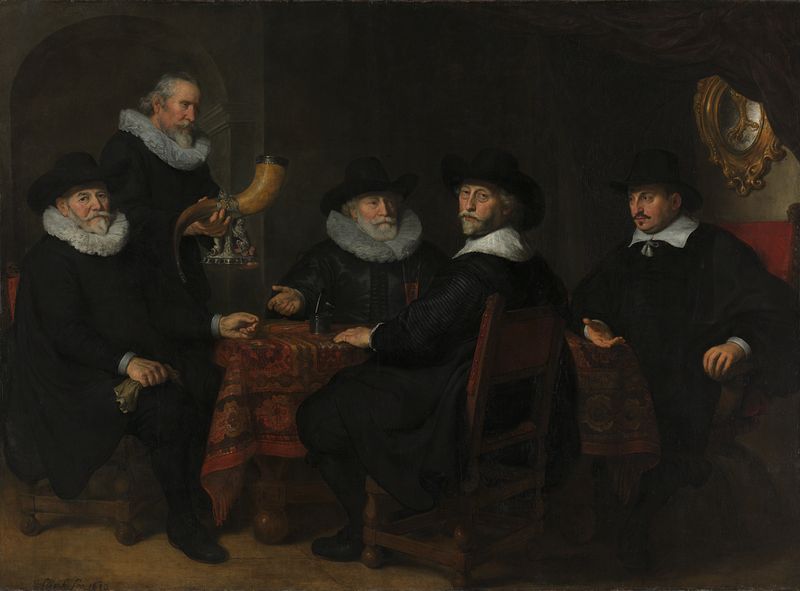

More Historical Art
Browse all →
The Night Watch Militia Company of District II under the Command of Captain Frans Banninck Cocq
Rembrandt van Rijn

Lincoln Memorial
Henry Bacon

The Third of May 1808
Francisco de Goya

Isaac and Rebecca, Known as ‘The Jewish Bride’
Rembrandt van Rijn

The Charge of the Mamelukes (1814)
Francisco de Goya

De vier ruiters van de apocalyps
Albrecht Dürer