
Orleans House, Twickenham — History & Facts
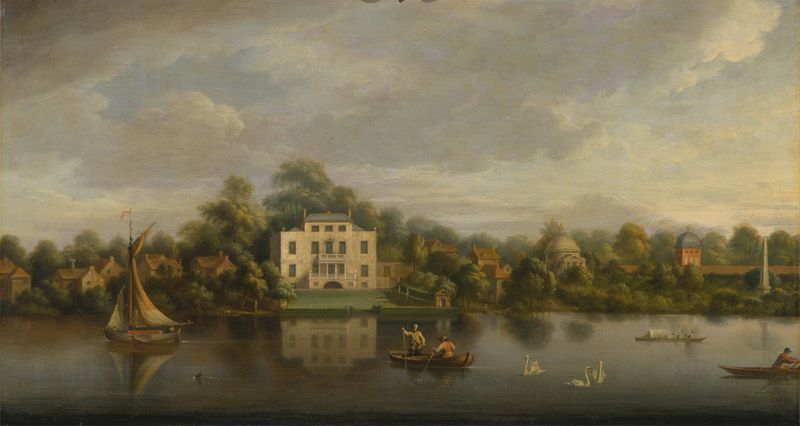
What if beauty was never meant to be finished? Within the echoes of time, there lies an obsession, a relentless pursuit of capturing the essence of place and memory. Look toward the center of the canvas, where the striking architecture of Orleans House emerges amid a tranquil landscape. The soft greens of the surrounding foliage cradle the structure, while dappled light dances across the walls, revealing the careful brushstrokes that highlight intricate details. Notice how the artist employs a warm palette, the golden hues infusing life into the scene, as shadows stretch and wane, capturing the quiet rhythm of the day. Hidden within this serene depiction lies a tension between permanence and transience.
The sturdy edifice stands as a testament to history, yet the gentle sway of the trees suggests change, hinting at the fleeting nature of beauty and existence. One can almost sense the artist’s longing imbued in the delicate play of light and shadow, inviting contemplation on what it means to preserve moments that always slip away. Joseph Nickolls created this work during the late 18th century, a time when England was enamored with picturesque landscapes and neoclassical architecture. His life in Twickenham was marked by a burgeoning interest in capturing the essence of local beauty, amidst the burgeoning Romantic movement that sought deeper emotional connections with the environment.
In an era where nature and human creation intertwined, he firmly established his artistic voice, reflecting the cultural zeitgeist of his time.
More Artworks by Joseph Nickolls
Browse all →
More Architecture Art
Browse all →
The statue of Liberty
Frédéric Auguste Bartholdi

View of Houses in Delft, Known as ‘The Little Street’
Johannes Vermeer

View of Houses in Delft, Known as ‘The Little Street’
Johannes Vermeer

The Cathedral in Rouen. The portal, Grey Weather
Claude Monet

The yellow house
Vincent van Gogh

The Church in Auvers-sur-Oise, View from the Chevet
Vincent van Gogh