Paris and Oenone — History & Facts
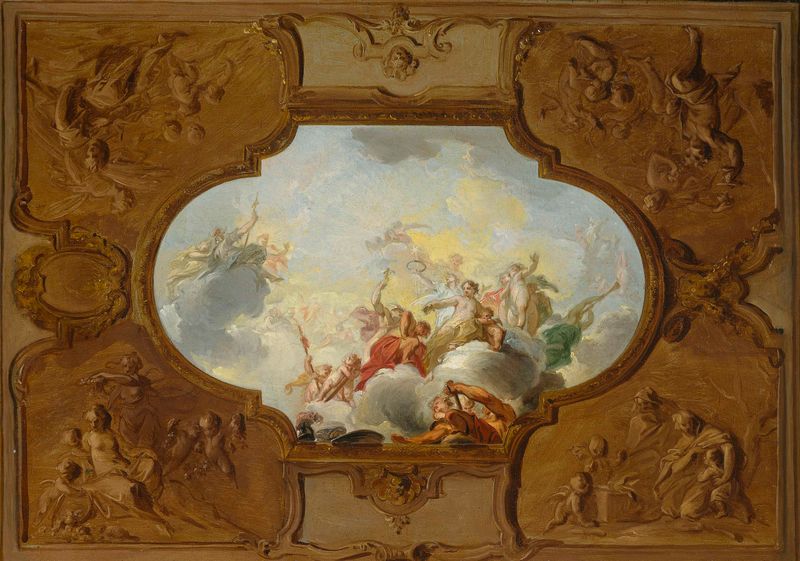
What if beauty was never meant to be finished? In the delicate interplay of figures and myth, this captivating work invites contemplation of love and divinity, eternally suspended in artistry. Look to the center where Paris, draped in luxurious fabrics, stands poised with an air of quiet confidence. The warm, golden hues envelop him, highlighting his chiseled features and the softness of his flowing hair. Notice how the light caresses the skin of Oenone, who gazes upwards with a mixture of yearning and reverence.
Their intertwining gestures suggest an intimate moment, while the soft brushwork brings a sense of movement and life to the scene, contrasting with the firm solidity of the classical architectural backdrop. Beneath the surface beauty lies a deeper tension—a juxtaposition of love and desire against the inevitability of choice. Paris is torn between the divine and the mortal, encapsulated in Oenone's longing expression. The figures are adorned with symbols of beauty and wisdom, yet their gazes tell a story of uncertainty, reflecting the perils of seduction.
The lush landscape hints at the bounties of nature, suggesting that true fulfillment is perhaps an unreachable ideal, continually pursued yet never fully attained. Jacob de Wit painted this work in 1737 while residing in Amsterdam, during a time when the art world was flourishing with neoclassical revival. As a skilled artist celebrated for his mythological themes, he navigated the elegance of both human emotion and divine presence, capturing the essence of the age’s fascination with ancient histories. This masterpiece becomes more than an image; it is a reflection of an era striving to balance beauty, choice, and the complexity of human experience.