Park mit weißem Haus — History & Facts
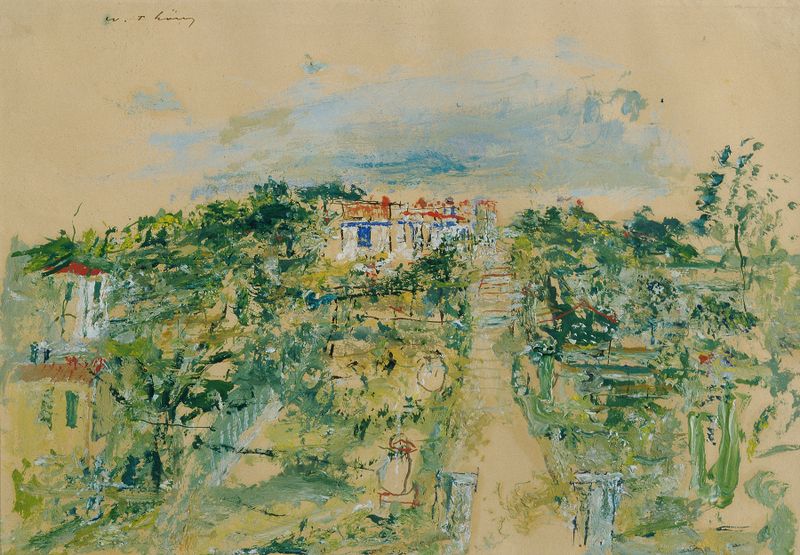
Truth often hides in the simplest of forms, whispering from the depths of color and composition. How do we reconcile the beauty and disorder in our lives? Focus on the vibrant greens that dominate the canvas, drawing your eye first to the lush foliage surrounding the white house. The play of light through leaves creates a dappled effect, inviting exploration.
Notice how the soft strokes of paint blend seamlessly, illustrating both the serenity of nature and the structured presence of the house that stands resolutely amidst it. The gentle contrast of white against deep greens evokes a sense of hope and tranquility, making this scene a refuge for the viewer. Hidden within this idyllic setting lies an emotional tension — the juxtaposition of the man-made and natural world. The house, a symbol of human presence, contrasts with the wildness that envelops it, suggesting a harmony yet to be fully realized.
The careful balance of color and form hints at stories untold, inviting contemplation on the relationship between civilization and nature. Each brushstroke breathes life into the scene, hinting at both peace and the underlying chaos of existence. In his career, the artist created Park mit weißem Haus during a transformative period for European art, influenced by the early 20th-century movements that sought to explore new ways of seeing. While the exact date remains unknown, Thöny's works often reflected his personal experiences and the shifting dynamics of society.
As an artist based in Vienna, he embraced the complexities of modernity, illustrating a world where beauty and truth could coexist, even in the face of uncertainty.