
Pastoral Landscape — History & Facts
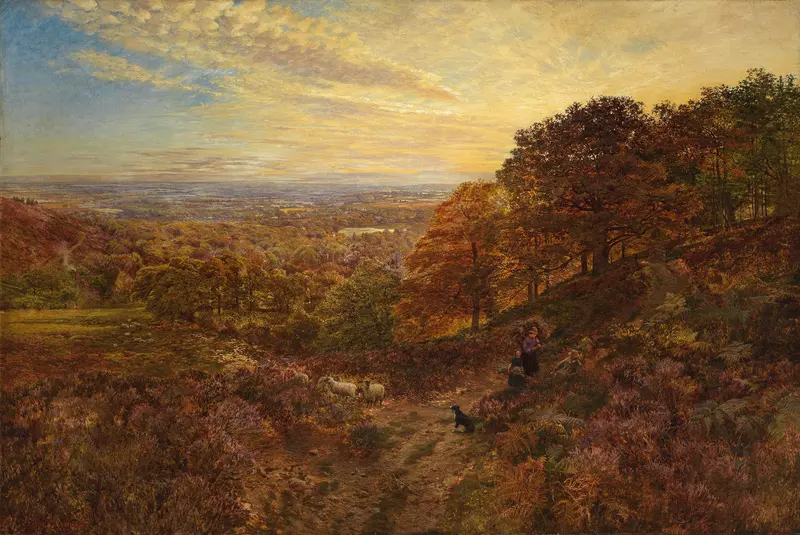
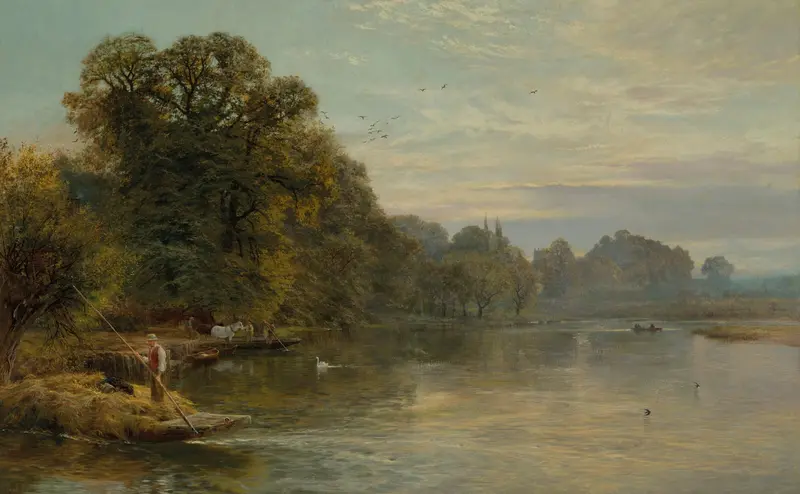
Look to the foreground of this tranquil expanse, where a gentle brook meanders through lush greenery, its shimmering waters capturing the golden hues of the sun. Notice how the soft strokes create a harmonious blend of earth and sky, with rich greens meeting the warm ambers of evening light. The balance of colors conjures a sense of serenity, yet the underlying brushwork holds a subtle restlessness—an invitation to explore deeper. In the distance, the rugged hills loom, their silhouettes dark against the horizon, which hints at nature's duality—beauty juxtaposed with harshness.
The stillness of the landscape is punctuated by grazing sheep, symbolizing innocence and the pastoral ideal, yet their presence also suggests vulnerability in a world that can quickly shift from peace to tumult. The artist’s choice of composition draws the eye toward the horizon, where the sky meets the land, evoking a yearning for what lies beyond. George Vicat Cole created this piece during the late 19th century, a time when the Romantic movement’s influence was waning and the Pre-Raphaelite Brotherhood was gaining momentum. He was based in England, where a growing appreciation for naturalism encouraged artists to capture the beauty of the English countryside.
Cole’s work often reflected this desire to portray the idyllic aspects of rural life amid the industrial changes defining his era.
More Artworks by George Vicat Cole

More Landscape Art

Starry Night
Vincent van Gogh

View of Delft
Johannes Vermeer

Water Lilies
Claude Monet

The Grand Canal, Venice, looking north-west from the Ca' Corner to the Ca' Contarini degli Scrigni, with the campanile of Santa Maria della Carità
Canaletto

Windsor Castle
Canaletto

The Grand Canal looking North-East from the Palazzo Dolfin-Manin to the Rialto Bridge
Canaletto