Road to the Village — History & Facts
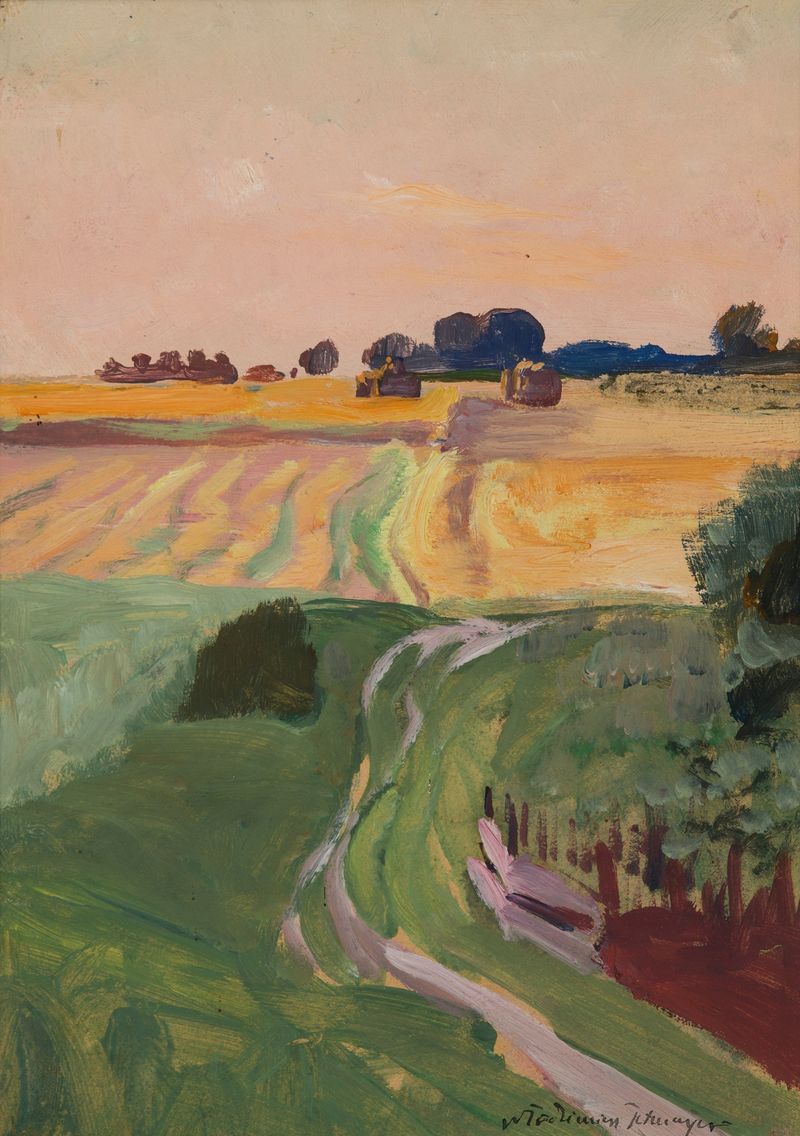
Can beauty exist without sorrow? Road to the Village, painted by Włodzimierz Tetmajer in 1911, invites us to ponder this profound question as it captures the interplay of tranquility and underlying tension within its pastoral setting. Look to the left at the winding dirt path that leads toward a distant village, where the warm hues of sunset saturate the sky with shades of orange and purple. Notice how the soft light bathes the figures in the foreground, their silhouettes almost merging with the landscape. The deliberate brushstrokes evoke a sense of movement — the villagers, caught in a fleeting moment, seem to travel not just physically but also emotionally, as if their journey carries the weight of history. The juxtaposition of the serene landscape with the figures’ expressions hints at deeper narratives of struggle and resilience.
The tension between the idyllic setting and the burdened faces suggests a society grappling with its past, especially in the context of the political unrest of early twentieth-century Europe. Each figure, rendered with care, seems to embody the scars of personal and collective stories, revealing that beauty can often coexist with the shadows of sorrow. At the time Tetmajer created this piece in Kraków, Poland was experiencing a cultural awakening intertwined with the echoes of conflict. Artists sought to capture both the beauty of the land and the complexities of their identities in a rapidly changing world, setting a poignant backdrop for works like this that reflect the coexistence of hope and despair.