Romersk prospekt med mur i forgrunden, kirke og ruin i baggrunden — History & Facts
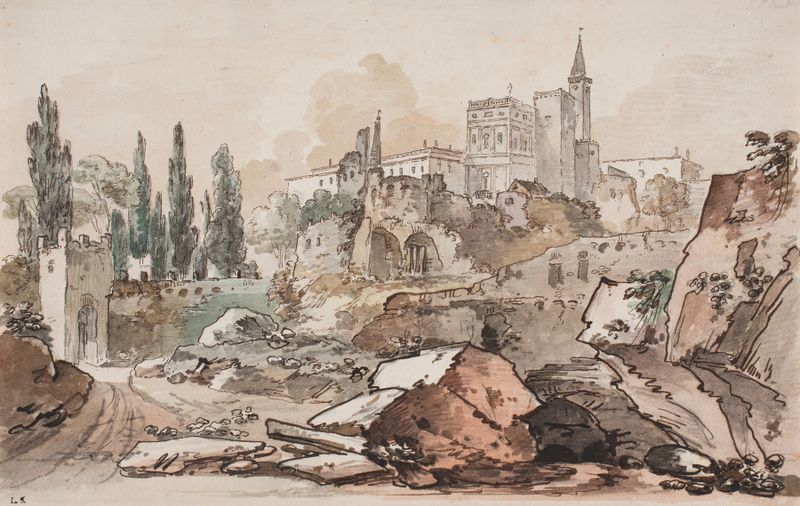
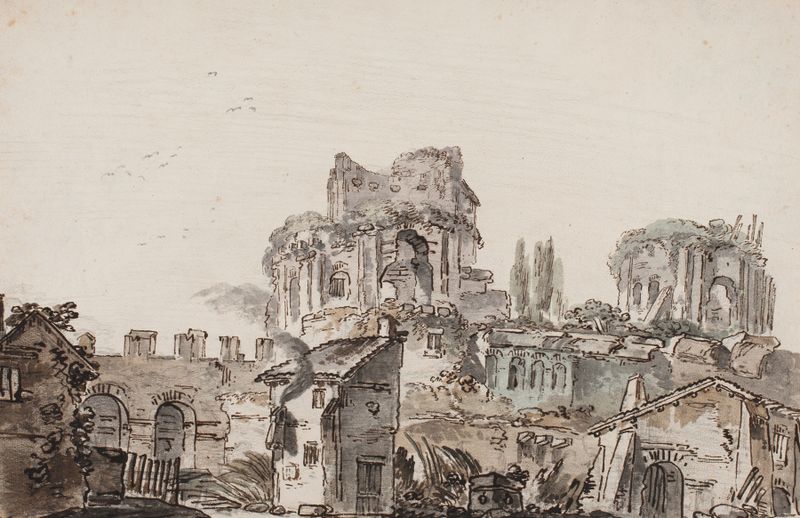
In the delicate brushstrokes of this piece, a profound melancholy permeates the atmosphere, inviting viewers to ponder the stories etched into the landscape. Look to the left, where the sturdy wall stands as a silent guardian, its weathered stones tinged with muted hues of grey and ochre. The composition gracefully leads the eye towards the distant church, its steeple reaching skywards, juxtaposed against the soft contours of ancient ruins nestled beneath a gentle sky. The palette is restrained yet poignant, each shade whispering tales of time lost and the echoes of lives once lived. The interplay between the solid wall and the fleeting forms of the church and ruin encapsulates a deeper narrative of resilience and transience.
Here, the wall symbolizes the barrier between the past and the present, while the church and ruins represent the fragility of memory. A subtle tension arises from this juxtaposition, evoking a bittersweet reflection on what remains versus what has been forgotten. Created between 1730 and 1790, the artist found inspiration in landscapes that merged history with the present. This period marked a time of artistic transition, as neoclassicism began to influence Scandinavian art, prompting a deeper exploration of identity and heritage.
In this context, the work emerges as a silent dialogue between the enduring and the ephemeral, capturing the essence of a world steeped in both beauty and loss.