
Rossauerkaserne — History & Facts
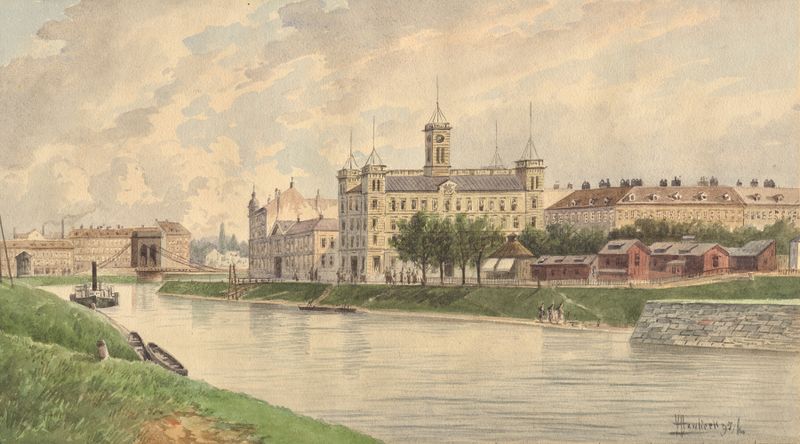
This profound transformation encapsulates the spirit of revolution, where turmoil morphs into something beautiful and profound. Look closely at the textured surface, where bold strokes intertwine in a dance of light and shadow. Focus on the central structure, the Rossauerkaserne, standing resilient amidst swirling hues of brown and green. The dynamic movement of the brushwork captures the energy of the moment, as if the building breathes among the chaos of its surrounding landscape.
The palette, a muted yet powerful blend, evokes the raw emotion of a time on the brink of change. In the foreground, shards of light pierce through the darker tones, hinting at hope and renewal amidst the upheaval. The juxtaposition of the stable architecture against the frenetic brushstrokes conveys a tension between solidity and fluidity, suggesting the push and pull of revolution itself. The vibrant colors and swirling forms create a visual narrative that speaks to the struggle and yearning for progress, inviting the viewer to ponder the deeper implications of this transformation. Vincenz Havlicek painted this work in 1892, a period marked by socio-political shifts in Europe.
Living in Austria, he was influenced by the cultural currents that sought to redefine identity and purpose in a rapidly changing world. The painting reflects not only his artistic evolution but also the broader aspirations of a society grappling with its future amidst the echoes of revolution.
More Artworks by Vincenz Havlicek
Browse all →




More Architecture Art
Browse all →
The statue of Liberty
Frédéric Auguste Bartholdi

View of Houses in Delft, Known as ‘The Little Street’
Johannes Vermeer

View of Houses in Delft, Known as ‘The Little Street’
Johannes Vermeer

The Cathedral in Rouen. The portal, Grey Weather
Claude Monet

The yellow house
Vincent van Gogh

The Church in Auvers-sur-Oise, View from the Chevet
Vincent van Gogh