
Ruins of the Aqueduct on the Roman Campagna — History & Facts
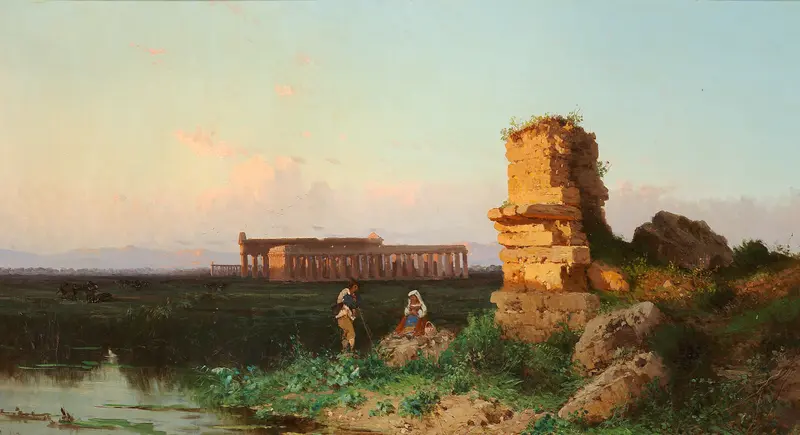
What first catches the eye in Ruins of the Aqueduct on the Roman Campagna is the way the ancient stonework rises like a monument to lost centuries, crowned with a tangle of living green. The aqueduct’s battered arches cast long shadows across the golden grass, while the last surviving pillar, draped in ivy, stands sentinel against a sky so open it seems to stretch history itself. The painter draws you in with the play of light: the warm glow on the ruins, the cool reflection in the water below, and the delicate haze of distant mountains.
Every brushstroke is a meditation on endurance—how nature and memory entwine, how the ruins are not just relics but actors in an ongoing story. This painting, made in 1869 by Alessandro La Volpe in oil on canvas, belongs to a moment when artists and travelers alike were captivated by the Roman countryside. The Campagna was a favorite subject for those seeking the poetry of ruins, a place where the ambitions of empire met the patient reclaiming hand of nature. Works like this were often collected by foreign visitors, eager to bring home a piece of Italy’s storied past.
Though little is recorded about this particular canvas beyond its measurements and date, it stands as a quiet witness to the 19th-century fascination with antiquity and landscape. Let your gaze linger on the aqueduct’s crumbling stones, and consider how many generations have looked on them with wonder.
More Artworks by Alessandro La Volpe

More Landscape Art

The Starry Night
Vincent van Gogh

View of Delft
Johannes Vermeer

Water Lilies
Claude Monet

The Grand Canal, Venice, looking north-west from the Ca' Corner to the Ca' Contarini degli Scrigni, with the campanile of Santa Maria della Carità
Canaletto

Windsor Castle
Canaletto

The Grand Canal looking North-East from the Palazzo Dolfin-Manin to the Rialto Bridge
Canaletto