Scena di pesca — History & Facts
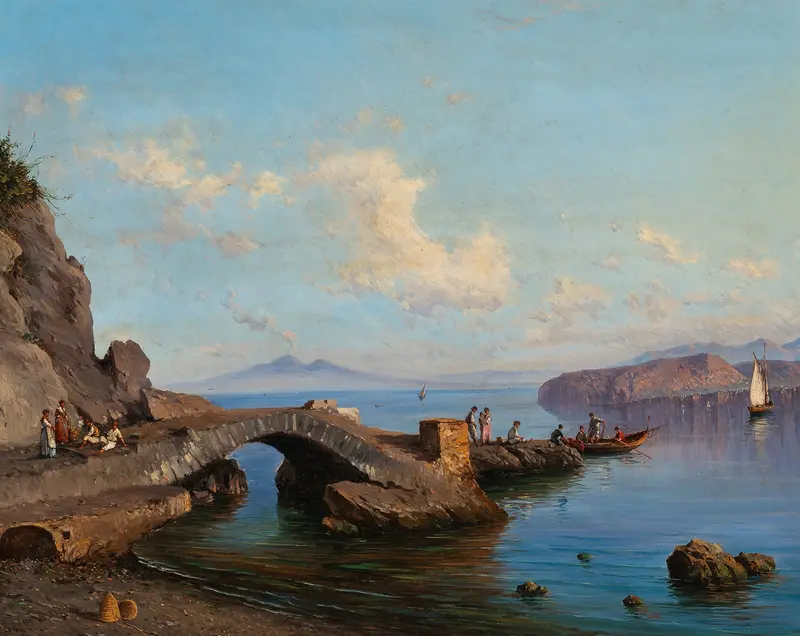
What first catches the eye in Scena di pesca by Alessandro La Volpe is the gentle hush of early morning, as if the Gulf of Naples itself is holding its breath. The painter leads you from the dark foreground rocks—solid, anchoring, and cool—out across the shimmering water to the twin sails of a fishing boat, poised mid-task. Light pours in from the right, picking out the crisp white of the sails and the gentle haze that softens the distant city and the unmistakable silhouette of Vesuvius, its plume of smoke curling quietly into the sky.
Every element, from the careful placement of boats to the subtle gradations of blue and pink in the sky, is orchestrated to draw the viewer into a moment of calm industry and natural grandeur. The low horizon gives the sky and volcano the leading role, making the human presence feel both vital and small. Painted in 1866, this work belongs to a period when Italian artists were increasingly drawn to the luminous possibilities of plein air painting and the picturesque life of the southern coasts. Scenes like this—celebrating the daily rhythms of fishing communities and the dramatic landscapes of the Bay of Naples—were sought after by travelers and collectors eager to bring home a fragment of Italy’s light and color.
While little is recorded about the journey of this particular painting, its survival in a modern collection invites us to see with nineteenth-century eyes: to marvel at the balance of labor and leisure, nature and civilization, all under the watchful presence of Vesuvius. The longer you look, the more the painting rewards your patience, revealing new harmonies between land, sea, and sky.