Saint Acacius (San Acacio) — History & Facts
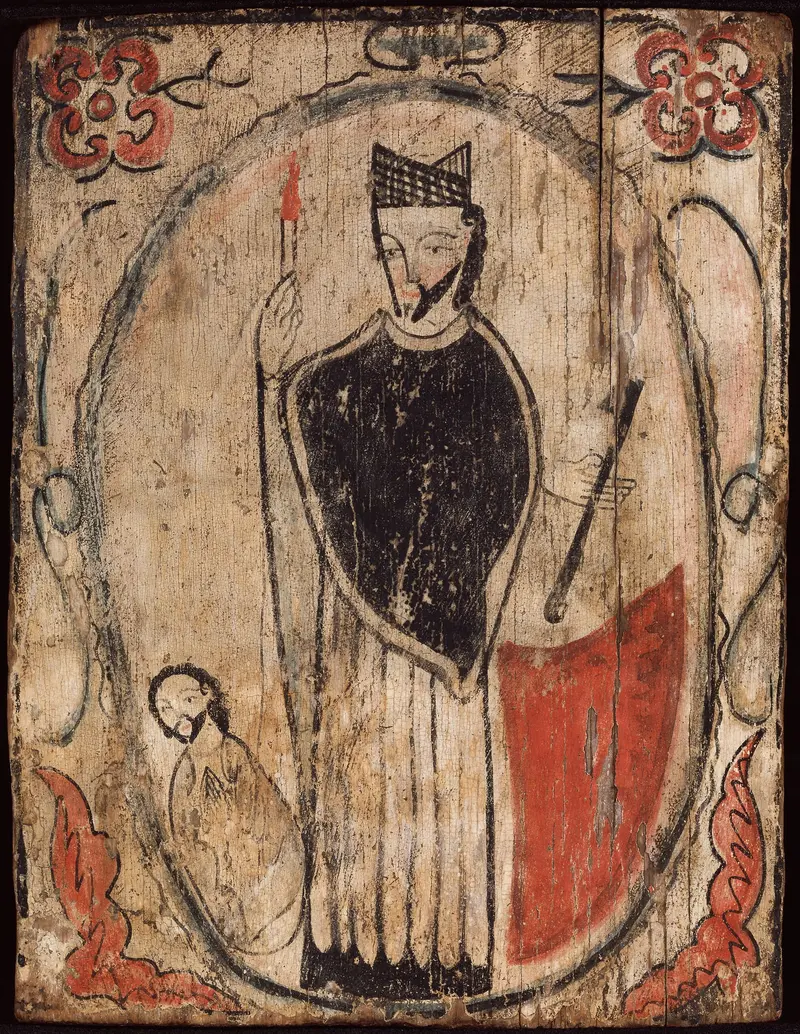
What first catches the eye in Saint Acacius (San Acacio) by Antonio Molleno is its striking directness—a crucified figure, arms stretched wide, flanked by two soldiers in vivid red, all enclosed in an oval frame that feels both intimate and ceremonial. The artist’s hand is unpolished but purposeful: the elongated body, the stylized wounds, and the almost childlike rendering of faces draw the viewer into a world where storytelling matters more than realism. The red flourishes and floral motifs scattered around the border are not mere decoration; they act as visual prayers, guiding attention back to the central drama.
The palette, dominated by earthy reds and blues, gives the scene an austere solemnity, while the flattened perspective and simplified forms suggest a work meant for contemplation rather than spectacle. History has kept few traces of Antonio Molleno or the precise origins of this painting, leaving us to place it within the broader tradition of devotional art that flourished in colonial Latin America. Such images were often created for small chapels or private homes, intended to make the mysteries of faith accessible to everyday worshippers. The Barnes Foundation, where this work now resides, preserves it as a rare witness to a world where faith, artistry, and local tradition intertwined.
The anonymity of its journey only heightens the sense of mystery—inviting us to look again at the painted faces, and to imagine the hands that once traced these lines in hope or sorrow.