Spanish landscape — History & Facts
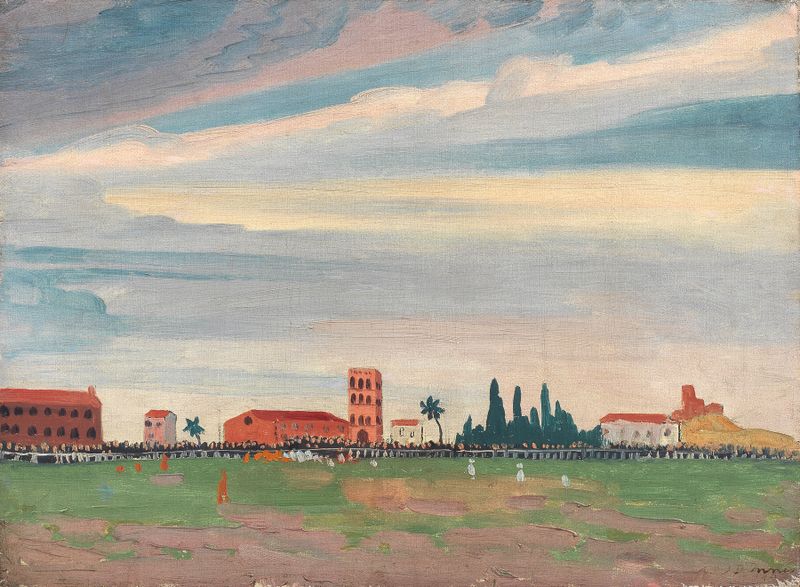
Could a single brushstroke hold eternity? In James Dickson Innes’s Spanish Landscape, time collapses into the expansive embrace of the horizon, where past and present intertwine in the amber glow of a sun-drenched day. Look to the left at the rolling hills, their undulating forms soft and inviting, painted with rich ochres and verdant greens. Notice how the light dances across the canvas, illuminating the textured strokes that breathe life into the land. The palette whispers of warmth, inviting the viewer to linger amid the vibrant hues, while the loose brushwork evokes a sense of spontaneity and freedom.
Each stroke seems to pulse with a rhythm of its own, creating a landscape that feels both familiar and dreamlike. Yet beneath the serene surface lies a profound contemplation of impermanence. The interplay of light and shadow hints at fleeting moments, where every shape and color carries the weight of time itself. The subtle contrast between the lush foreground and the distant mountains invites reflection on the transient nature of beauty, echoing the ephemeral experience of life.
It is a reminder that these moments, once captured, are forever etched in the canvas of memory. Completed in 1912, this work emerged during a pivotal time for the artist, who was exploring his identity amidst the modernist movements sweeping Europe. Residing in a period marked by change and innovation, Innes was influenced by the rich landscapes around him as well as the evolving artistic language of his contemporaries. This painting embodies his quest to reconcile the traditional with the modern, celebrating the essence of place and time in a world rapidly transforming.