
Stiftsportal Klosterneuburg — History & Facts
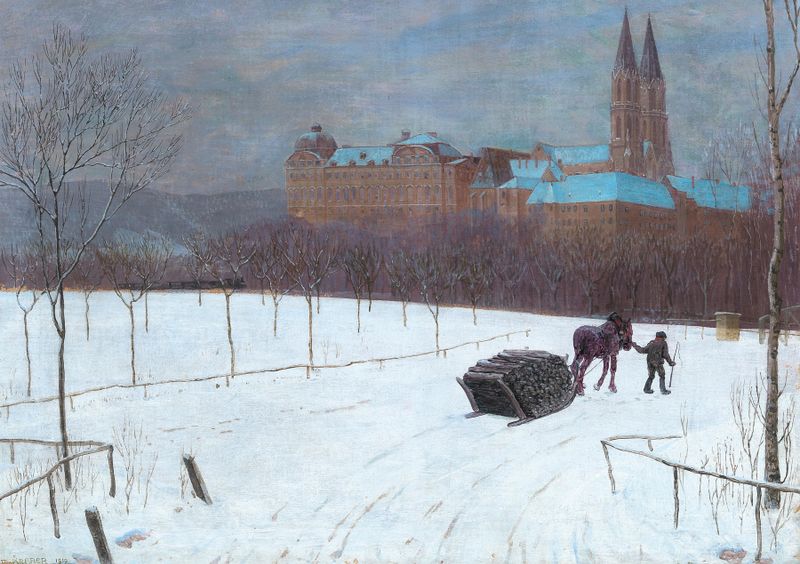
Can paint confess what words never could? Max Kahrer's Stiftsportal Klosterneuburg speaks volumes about the intricacies of betrayal and hidden truths, weaving an intricate narrative within its strokes. Look to the left at the ornate archway that frames the scene, inviting viewers into a world steeped in historical significance. Notice the interplay of light and shadow as it dances across the stone, each facet revealing the craftsmanship of a bygone era. The muted palette enhances the solemnity, while the meticulous detailing draws the eye to the figures adorning the portal—each expression suggesting untold stories and unspoken alliances. Delve deeper into the interactions between the figures and the architectural elements surrounding them.
The contrasting light on the stone and the figures hints at the dual nature of existence—between the sacred and the profane, the known and the hidden. Each character, with their unique posture and gaze, seems to grapple with the weight of their choices, reflecting the artist's exploration of loyalty and betrayal, evoking a sense of tension that resonates through the ages. In 1924, Kahrer painted this piece during a time of significant change in Austria, following the devastation of World War I. The nation was in the throes of rebuilding, both physically and culturally.
Kahrer, immersed in the Viennese art scene, sought to capture not just architectural beauty but the complex emotions tied to historical narratives, infusing his work with a deeper understanding of humanity’s flaws and the echoes of betrayal that linger within the walls of history.
More Artworks by Max Kahrer
Browse all →





More Architecture Art
Browse all →
The statue of Liberty
Frédéric Auguste Bartholdi

View of Houses in Delft, Known as ‘The Little Street’
Johannes Vermeer

View of Houses in Delft, Known as ‘The Little Street’
Johannes Vermeer

The Cathedral in Rouen. The portal, Grey Weather
Claude Monet

The yellow house
Vincent van Gogh

The Church in Auvers-sur-Oise, View from the Chevet
Vincent van Gogh