Strandgezicht met vissers bij een boot op de voorgrond — History & Facts
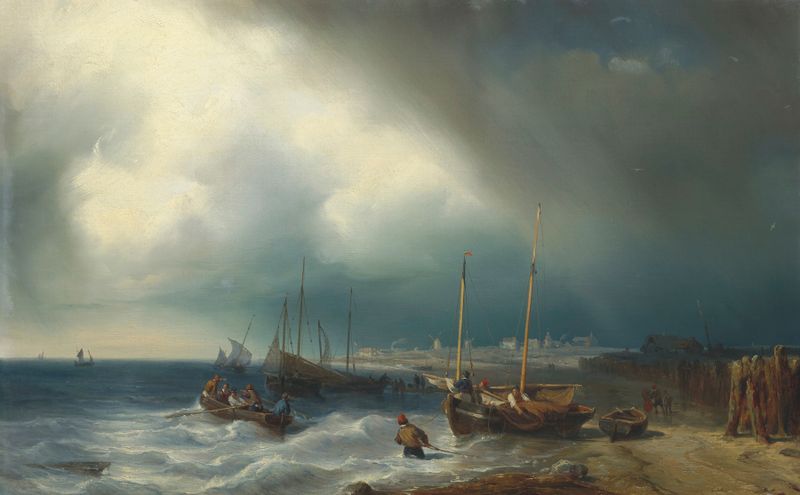
What if silence could speak through light? In Strandgezicht met vissers bij een boot op de voorgrond, the interplay of shadow and illumination whispers a tale of quiet turmoil beneath the surface. Look to the foreground where a weathered boat rests, almost cradled by the sand. The fishermen, stooped and engaged in their labor, draw the viewer's gaze; their figures are silhouetted against the expansive sea, capturing the stark contrast between man and nature. The muted palette evokes a sense of melancholy, while soft highlights dance on the water’s surface, suggesting a fleeting moment suspended in time.
The overall composition guides your eye naturally toward the distant horizon, where the sky meets the sea, creating an infinite sense of space that contrasts with the intimate focus on the fishermen. Yet, beneath this serene tableau lies a tension that hints at madness—the fishermen's faces, etched with exhaustion and resolve, reflect a struggle that transcends their physical labor. The stillness of the scene belies an underlying chaos, as if the winds of change are poised just beyond the frame. The rippling water serves as a metaphor for the unpredictability of fate, while the boat, laden with untold stories, symbolizes a journey both literal and existential. Louis Meijer created this piece during a period of personal and artistic exploration in the 19th century, a time when the Netherlands was grappling with its identity amidst modernity.
His work often reflected the duality of human experience, captured poignantly in this scene that combines the ordinary with profound emotional depth.