Street towards Dürnstein — History & Facts
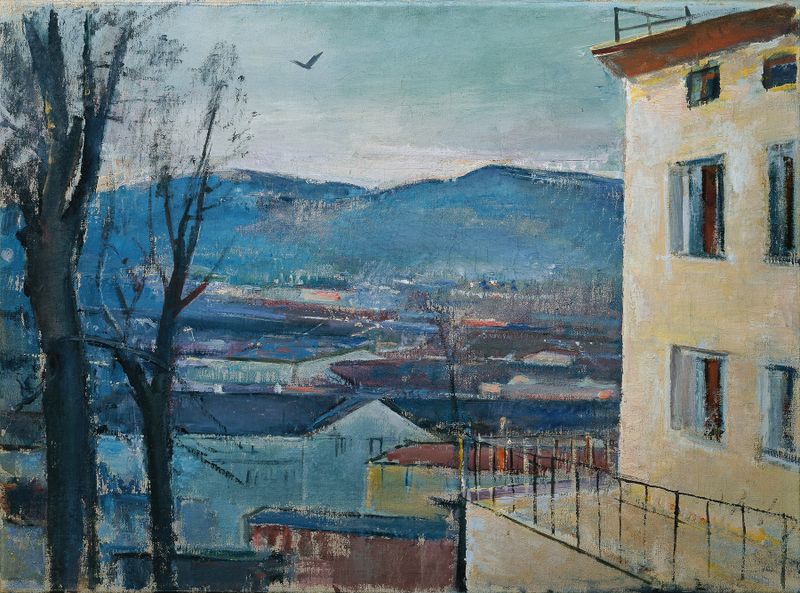
In the stillness of a painted street, life teeters on the brink of fragility, suspended between the vibrant and the disquieting. The path winds like a whispered secret, inviting us to navigate its emotional landscape, where every brushstroke carries the weight of existence. Look to the left at the tall, slender trees, their branches swaying gently as if caught in a breeze that refuses to arrive. Notice how the muted palette of blues and browns harmonizes with bursts of sunlight, illuminating the cobblestone path ahead.
The skillful interplay of light and shadow draws your gaze deeper into the scene, revealing a sense of movement balanced by an underlying stillness, reminiscent of the uncertainty that often accompanies change. As you explore the painting further, subtle tensions emerge. The narrowness of the street suggests confinement, while the expansive sky overhead offers an escape, evoking the push and pull between desire and restraint. The juxtaposition of the stark architecture against the softer natural elements speaks to the human struggle against the encroaching forces of modernity.
Each detail whispers of a delicate balance, reflecting the fragility not only of the physical world but of the emotions entwined within it. In 1913, while Faistauer created this evocative piece, Europe was on the cusp of profound transformation. The artist worked in Vienna, a hub of creativity and innovation, yet the simmering tensions of the era heralded the onset of World War I. Amidst this backdrop, Faistauer’s reflections on landscape and emotion reveal a deep engagement with the changing world, capturing a moment that resonates with both beauty and unease.