
Swale Land — History & Facts
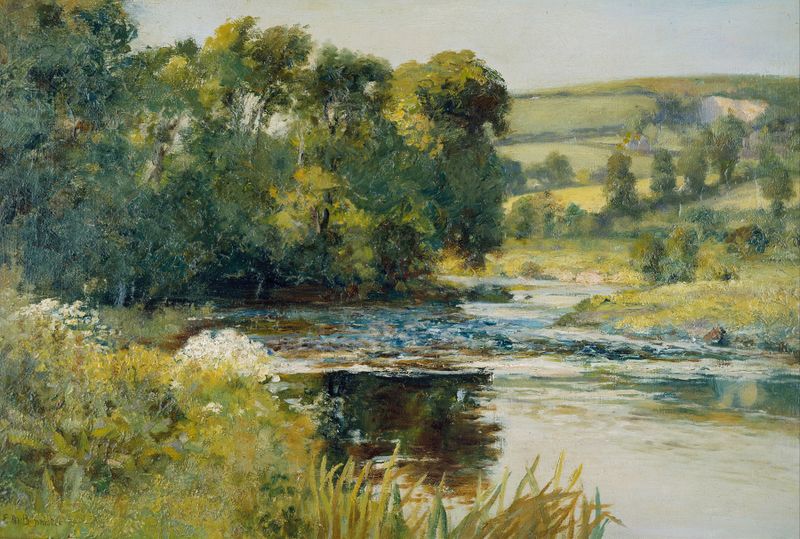
Is this a mirror — or a memory? In Swale Land, the landscape unfolds as a tangled dialogue between reality and reflection, revealing profound truths lurking beneath serene surfaces. Look to the left at the gentle curves of the rolling hills, where the horizon dances under a warm, golden light. Bannister's brushwork creates a lush, tactile quality in the foliage, drawing the eye into the deep greens and soft earth tones that breathe life into the scene. Notice how the light falls upon the water's surface like a whisper, capturing the delicate interplay of shadow and illumination that adds depth and complexity to the composition. Bannister's choice of color evokes a sense of peace, yet the viewer senses an undercurrent of longing.
The shimmering water, reflecting the sky above, raises questions about perception and memory. Are we witnessing a moment frozen in time, or a fleeting recollection of a place once known? The contrast between the vibrant colors of nature and the muted tones of the water suggests a duality of existence, echoing the struggle between reality and the elusive nature of human experience. In 1898, when this piece was created, Bannister was living in Providence, Rhode Island, where he was a significant figure in the American art scene, particularly among the artists of the Boston School. He faced both racial prejudice and personal challenges but continued to innovate within the realms of impressionism and realism.
His commitment to exploring the interplay of light and color positioned him as a pioneer in depicting landscapes that were not just seen but felt, contributing to a broader understanding of African American art in a shifting cultural landscape.
More Artworks by Edward Mitchell Bannister
Browse all →
Landscape
Edward Mitchell Bannister
Streamside
Edward Mitchell Bannister

Untitled
Edward Mitchell Bannister

On the Seekonk
Edward Mitchell Bannister

Morning on the Shore
Edward Mitchell Bannister

Summer Twilight
Edward Mitchell Bannister
Homeward
Edward Mitchell Bannister
Landscape
Edward Mitchell Bannister
Rocks at Newport
Edward Mitchell Bannister

Sunset
Edward Mitchell Bannister





