
The Battle of Nördlingen — History & Facts
The clash of steel rings through the air, a cacophony of chaos and valor. Soldiers, caught in the throes of battle, fight not just for victory but for survival, their faces painted with determination and dread. Sunlight douses the scene, illuminating the vibrant hues of armor and the rich tapestry of the ground, where dust and blood mingle in a tragic dance. Focus on the left side of the canvas, where the vivid reds and blues of the uniforms command immediate attention.
The artist's precise strokes reveal not just the action but the weight of each moment—look closely at the swirling clouds of smoke that snake between the combatants, almost as if the very air is alive with tension. Notice how the shadows fall dramatically, creating depth and drawing the viewer into the inferno of conflict, while the brightness of the sky above contrasts with the dark realities of war below. In this intricate tableau, the colors serve more than mere decoration; they embody the emotional stakes of the struggle. The juxtaposition of bright hues against the muted earth tones illustrates the thin line between glory and despair, capturing the fleeting nature of heroism on the battlefield.
Hidden within the chaos are faces of both pride and anguish, reflecting the duality of war, where triumph often comes at a heavy price. Created in 1634 during a period of significant political upheaval in Europe, The Battle of Nördlingen was painted by Snayers while he resided in the Spanish Netherlands. At that time, the Thirty Years' War was raging, influencing the artist's focus on military themes. Snayers, known for his dramatic depictions of battles, sought to encapsulate the heroism and tragedy of warfare, his work resonating with the collective memory of a continent torn apart.
More Artworks by Peter Snayers
Browse all →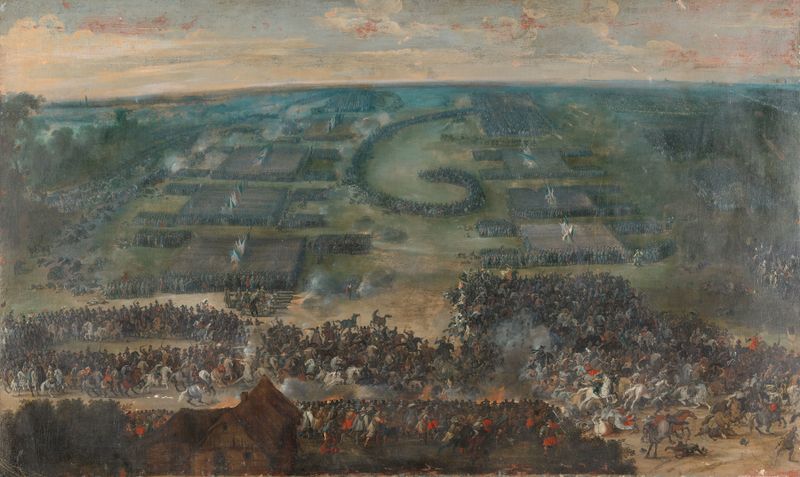
More Historical Art
Browse all →
The Night Watch Militia Company of District II under the Command of Captain Frans Banninck Cocq
Rembrandt van Rijn

Lincoln Memorial
Henry Bacon

The Third of May 1808
Francisco de Goya

Isaac and Rebecca, Known as ‘The Jewish Bride’
Rembrandt van Rijn

The Charge of the Mamelukes (1814)
Francisco de Goya

De vier ruiters van de apocalyps
Albrecht Dürer