The Five Senses: Hearing — History & Facts
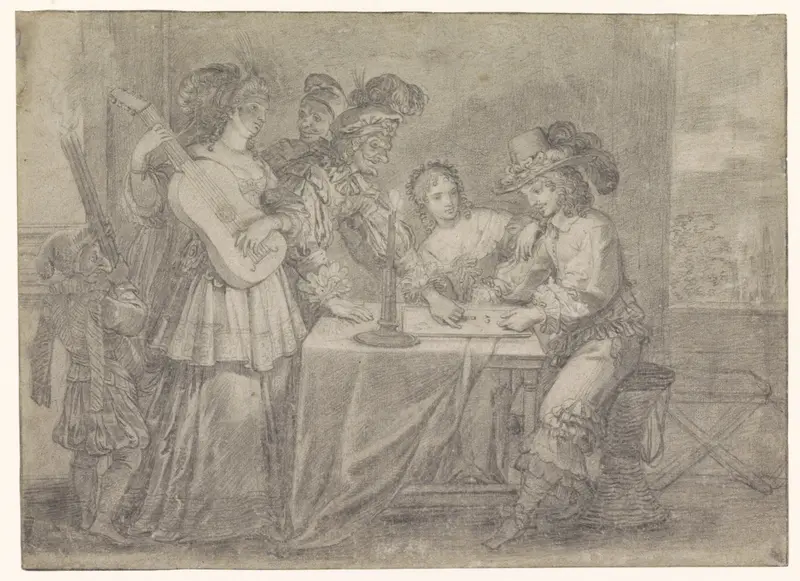
What first catches the eye in The Five Senses: Hearing by Abraham Bosse is the poised, almost theatrical harmony of a group absorbed in music-making, as if the room itself is holding its breath. The figures, richly dressed and intent on their scores, form a tight circle around a table scattered with open books—each detail pulling the viewer closer into the intimacy of their shared moment. Light pours in through the open window, illuminating faces and instruments, while the world outside seems to recede into a blur of banners and horses, hinting at a distant commotion that contrasts with the calm concentration within.
The gesture of the woman with the lute, her fingers delicately poised, draws attention to the act of listening as much as playing, while the attentive gaze of her companions completes a silent conversation. Even the velvet drapery and thick tablecloth seem to hush the space, heightening the sense that here, in this room, music is both shield and sanctuary. Painted around 1635, this work belongs to a period when allegories of the senses were a favored theme among collectors and artists alike, each sense given its own tableau of daily life or courtly ritual. In the bustling world of seventeenth-century Europe, such paintings were not mere decoration but invitations to contemplate the pleasures and powers of human perception—often commissioned by the well-to-do as tokens of refinement and learning.
Abraham Bosse, active in France, was known for his keen observation of bourgeois society, and here he brings to life the era’s fascination with music as a symbol of harmony, intellect, and polite company. The painting now resides in the Web Gallery of Art’s digital collection, a reminder that history has kept few traces of its original setting or patrons. Yet the scene endures, inviting us to imagine the sound that once filled this room, and to notice the quiet drama unfolding in every gesture.