The Peaceable Kingdom — History & Facts
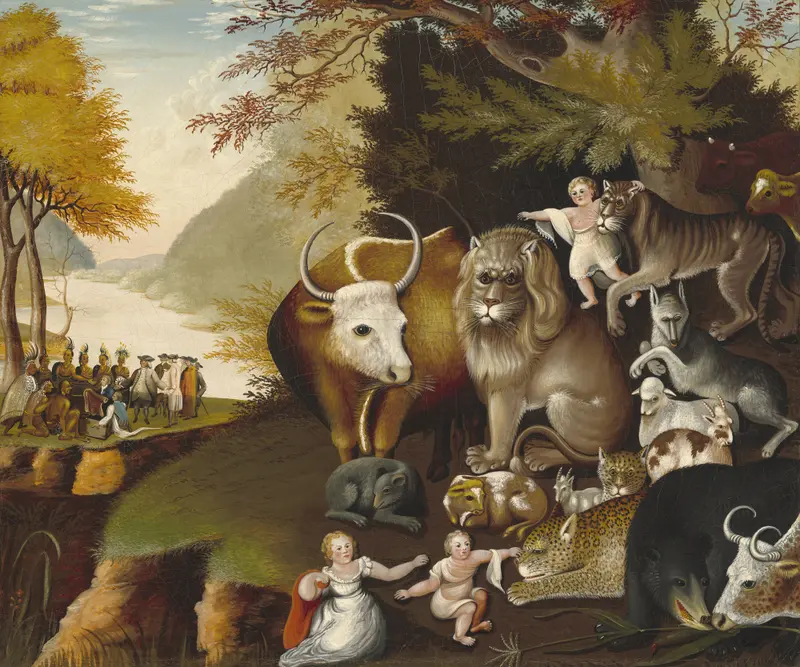
A child dressed in a red and blue drapery stands beside a lion at the edge of a wooded riverbank in this early version of The Peaceable Kingdom by Edward Hicks, painted between 1816 and 1818. The foreground features an unlikely gathering of animals including a wolf, lamb, leopard, goat, and ox, rendered in a simple, direct style. Rolling hills, clustered trees, and a calm river fill the middle ground, while a soft sky with scattered clouds completes the tranquil setting.
The use of clear outlines and flat areas of color reflects the artist’s self-taught technique. Edward Hicks frequently depicted this theme, drawing on biblical prophecy to imagine a world where creatures coexist in harmony. The composition brings the animals into close proximity, each rendered with distinctive markings and attentive expressions. The child’s gesture—resting a hand on the lion—serves as a central focus, reinforcing the ideal of peace among all creatures.
Hicks’s palette is dominated by earthy greens and browns, enlivened by the red of the child’s garment and the delicate pinks of nearby flowers. This painting is one of the earliest surviving versions of The Peaceable Kingdom, a subject Edward Hicks revisited throughout his career. It was created during the artist’s early years as a Quaker minister in Pennsylvania, reflecting his religious beliefs and the influence of Quaker ideals of peace. The work is currently held in the collection of the Cleveland Museum of Art.