Tourments d'amour — History & Facts
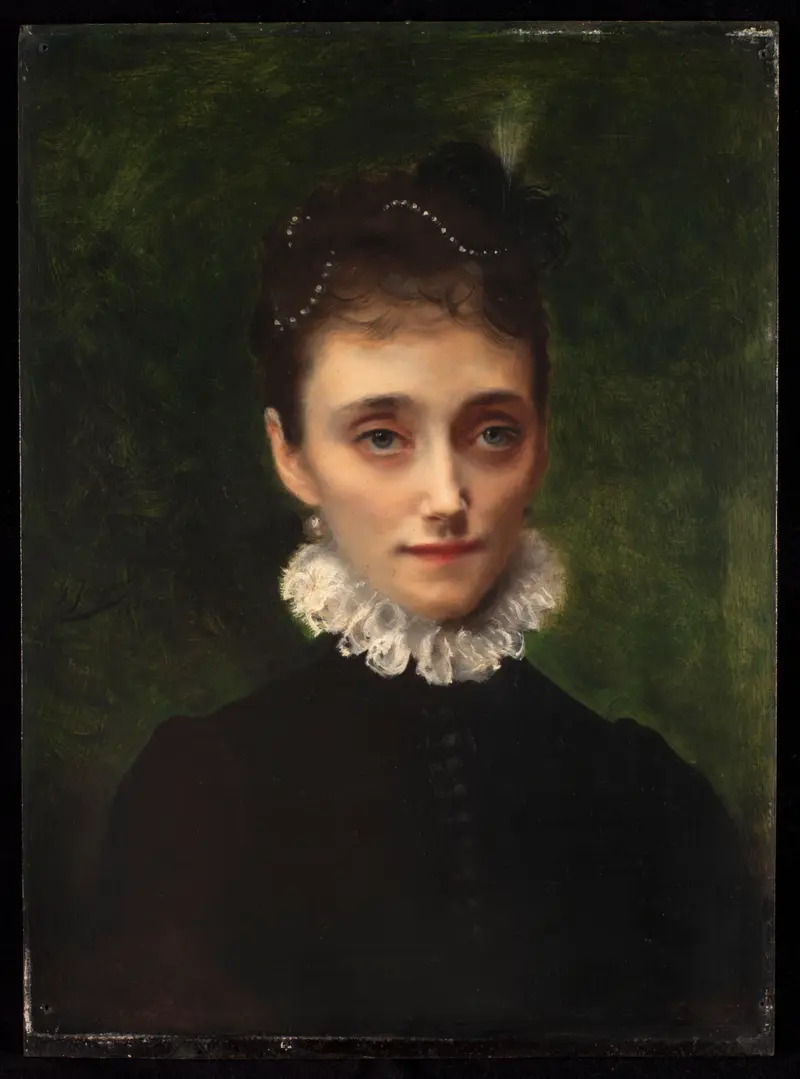
What draws the eye first in Tourments d'amour is the charged stillness of the young woman's gaze—her head turned just so, as if she has been caught in a moment of private reckoning. The light, soft but insistent, falls across her cheek and throat, modeling the delicate architecture of her face and the tension in her lips. Her dark hair, piled high and slightly untamed, frames a countenance that is both open and guarded.
The black bow at her neck is no mere ornament: it anchors her in the present, a note of drama against the pale, almost luminous fabric of her dress. The background recedes into shadow, refusing to distract from the psychological immediacy of her expression. Works like this, produced in the late nineteenth century, were prized for their ability to capture not just likeness but the inner weather of their sitters. Gustave Jean Jacquet was known for his refined technique and his portraits of women that hovered between idealization and acute observation.
The genre flourished in salons and private collections, where such paintings offered viewers both a mirror and a mystery—an invitation to speculate on the sitter’s story. Today, Tourments d'amour resides in the Musée d'art et d'histoire de Saint-Brieuc, its origins and commission largely unrecorded, a reminder that history often preserves the face but not the name. The unanswered questions in her eyes are yours to finish.