Tow Men Contemplating Ancien Ruins — History & Facts
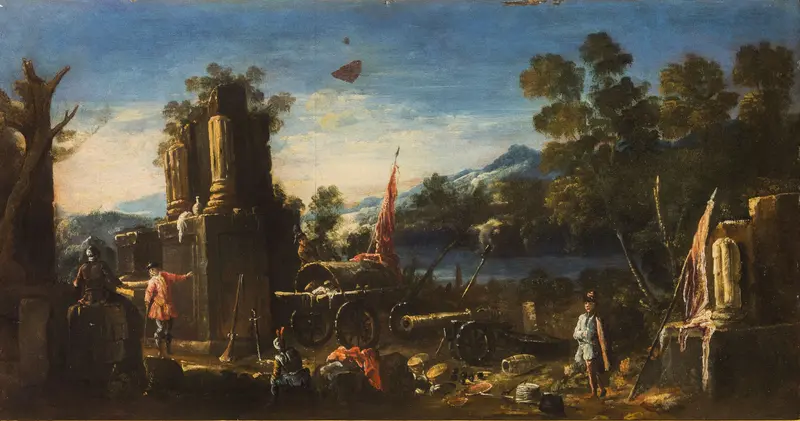
A city of stone dreams rises beneath a sky streaked with gold, where two small figures pause in awe before the silent testimony of vanished empires. The eye is drawn first to the grand urn perched atop a pedestal, a relic crowned by the morning light, around which the ruins spiral outward—columns toppled, friezes half-buried, statues frozen in mute witness. The two men, dwarfed by the scale of the architecture, gesture and confer, their presence a reminder of the human urge to understand and measure the past.
The palette—warm ochres and cool blues—sets a mood of discovery tinged with melancholy, as if the ruins themselves are both invitation and warning. Every detail, from the curling volute to the carved reliefs, is placed to guide the viewer deeper into this labyrinth of memory. Works like this Architektur-Capriccio by Antonio Stom flourished in the eighteenth century, when Europe’s fascination with antiquity reached fever pitch. Such capriccios—fantastical architectural scenes—were prized by collectors and travelers on the Grand Tour, who saw in them both a celebration of classical ideals and a meditation on the passage of time.
Painted around 1750, this piece, now in the Dorotheum collection, is typical of its era: a stage set for reverie, not a record of any real city, but a composite assembled from the artist’s imagination and the visual vocabulary of Rome and Venice. History has kept few traces of Stom himself, but his ruins still invite us to wander, to wonder, and to lose ourselves in the shadows of what once was.