
Military encampment — History & Facts
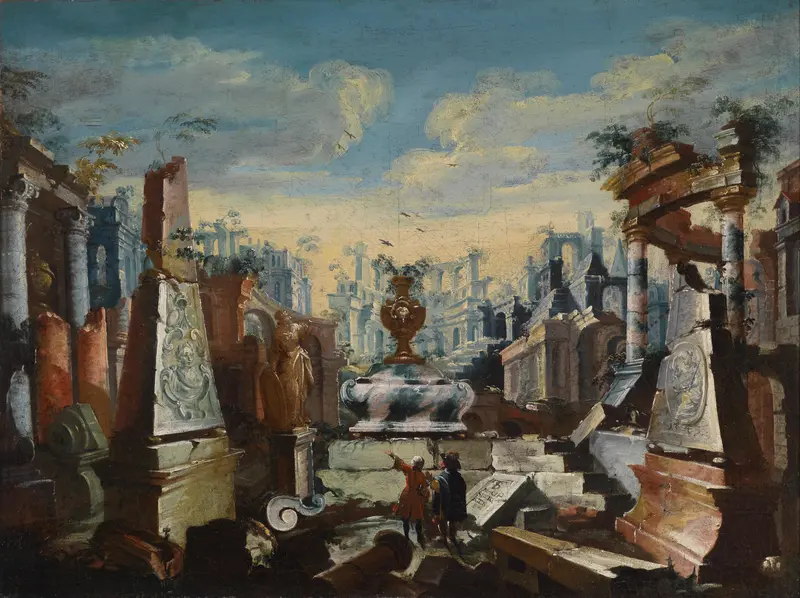
What first draws the eye is the sense of aftermath—soldiers scattered among ancient ruins, their banners drooping and their cannons idle, as if the frenzy of battle has given way to uneasy rest. The light falls across toppled columns and battered equipment, picking out the gleam of armor and the faded red of a standard, while the sky stretches wide and blue above the silent encampment. Each figure is caught in a moment of pause: one gestures toward the ruins, another sits in watchful repose, while a third stands apart, lost in thought.
The clutter of drums, helmets, and discarded gear in the foreground tells of recent action, but the overall mood is one of quiet vigilance. The painter uses the contrast between the golden ruins and the deep shadows to suggest both the passage of time and the uncertainty of what comes next. Works like this, created in the early eighteenth century, often served as meditations on war and its place in the landscape of history. The date range for Military encampment by Antonio Stom—between 1707 and 1734—places it in an era when Europe was reshaping itself through conflict and negotiation, and images of camps, ruins, and soldiers were both topical and popular.
Such paintings were collected by patrons who sought reminders of military glory or the fragility of power, and artists like Stom drew on the tradition of capriccio—fantastical landscapes mixing real and imagined ruins—to set the stage for their dramas. Little is recorded about this specific work’s origins or travels, but its presence in a modern collection invites us to look again at the uneasy peace that follows every campaign, and to wonder what stories these silent figures might tell.
More Artworks by Antonio Stom

More Landscape Art

The Starry Night
Vincent van Gogh

View of Delft
Johannes Vermeer

Water Lilies
Claude Monet

The Grand Canal, Venice, looking north-west from the Ca' Corner to the Ca' Contarini degli Scrigni, with the campanile of Santa Maria della Carità
Canaletto

Windsor Castle
Canaletto

The Grand Canal looking North-East from the Palazzo Dolfin-Manin to the Rialto Bridge
Canaletto