Venice, sail boats in the Bacino di San Marco — History & Facts
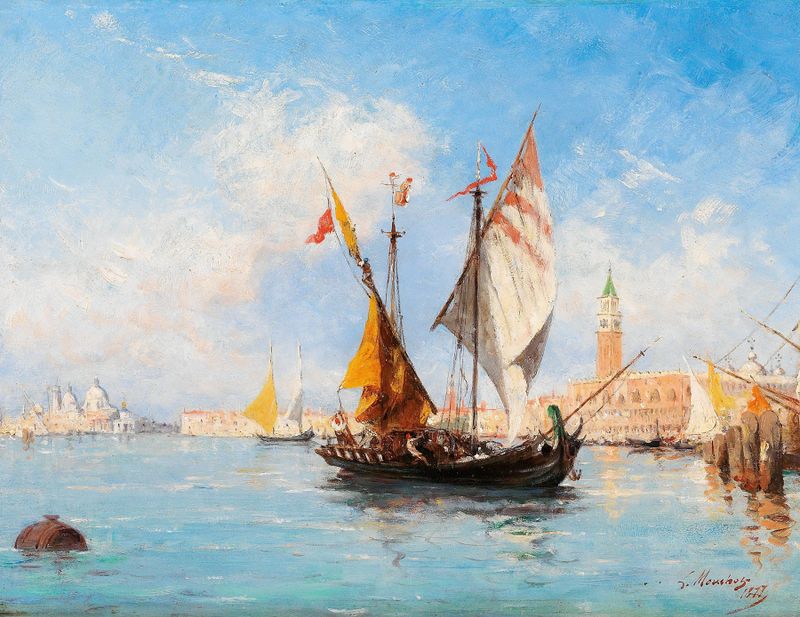
Could beauty survive in a century of chaos? In the midst of a rapidly changing world, Venice, sail boats in the Bacino di San Marco captures a fleeting moment of serenity amidst a backdrop of turbulent times. Begin by focusing on the gentle strokes of blue and green that dance across the canvas, evoking the tranquil waters of the Bacino. Look closely at the sailboats, their billowing sails catching the light in a delicate interplay of whites and creams. Notice how Mouchot's careful brushwork reflects not just the beauty of Venice, but also invites the viewer to absorb the subtleties in the rippling water below, shimmering with hints of warmth from the sun, creating a vibrant contrast against the cool, shadowy architecture of the city. Delve deeper, and you will find layers of meaning hidden within the painting.
The sailboats, symbols of adventure and exploration, seem suspended in time, underscoring a tension between freedom and the constraints of a city steeped in tradition. The juxtaposition of the serene water against the looming structures of Venice might echo the madness of the social changes sweeping through Europe at the time, where the old world clashed with the new, leaving beauty to navigate through chaos. Louis Claude Mouchot painted this work in 1877 during a time when Impressionism was gaining traction in Europe, and traditional artistic techniques were being challenged. Living in Paris, he was influenced by the changing art landscape and the innovations of his contemporaries.
His depiction of Venice not only showcases the enchanting city but also reflects the artist's desire to capture ephemeral beauty amid the turbulence of an era on the brink of modernity.