Venice, sail boats in the Bacino di San Marco — History & Facts
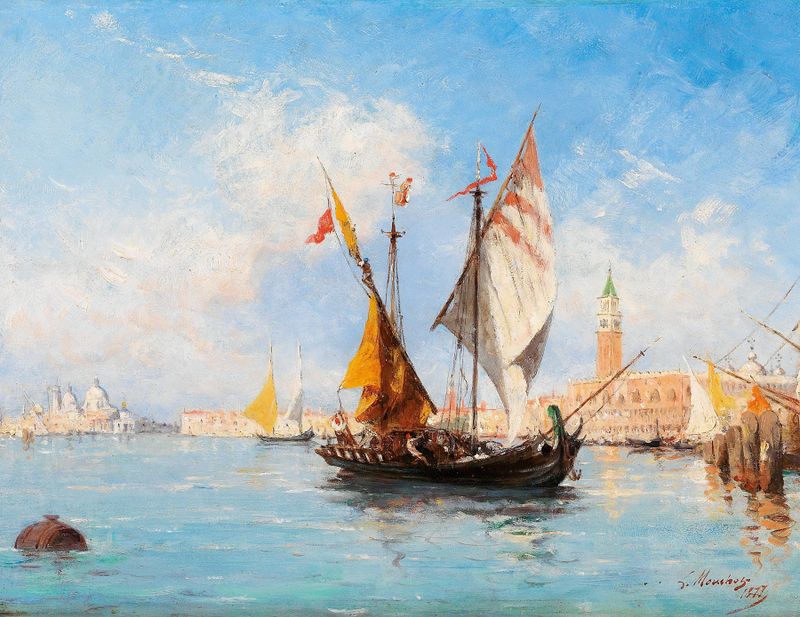
Can beauty exist without sorrow? This question lingers like a whisper in the shimmering waters of the Bacino di San Marco, where divine elegance meets the fleeting shadows of human experience. Look closely at the expansive canvas, where the gentle undulations of the water draw your gaze to the right. Here, sailboats glide serenely, their white sails catching the soft hues of a setting sun. Notice the interplay of light as it dances on the surface, creating a mosaic of gold and blue that evokes both tranquility and a hint of melancholy.
Mouchot's delicate brushwork invites you to explore every stroke, revealing a world that is both idyllic and transient. Beyond the surface beauty, the scene suggests deeper layers of longing. The boats, though still, hint at the movement of life and the inevitability of change. The horizon, a faint line between sky and water, symbolizes the divide between aspirations and reality, while the soft colors evoke a sense of nostalgia for fleeting moments.
Each element serves as a reminder that beauty often coexists with the ephemeral nature of existence. During the time this piece was created, the artist was exploring the vibrant colors and scenes of Venice, a city that had long captivated painters and poets alike. While the precise date remains unknown, Mouchot's work reflects an era marked by a fascination with capturing light and atmosphere in art. The late 19th century was a time of artistic innovation, and this painting embodies the spirit of exploration and emotional depth that characterized the period.