
Verwundetentransport — History & Facts
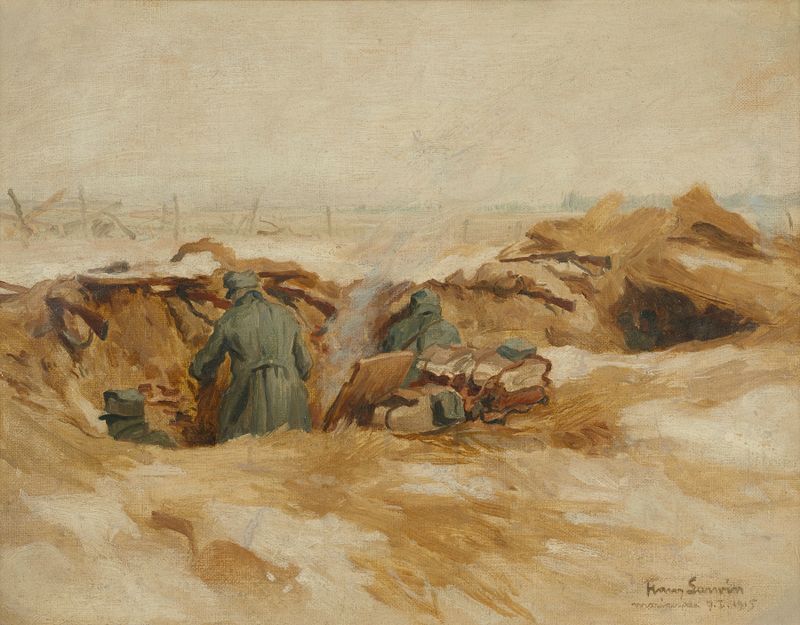
In the aftermath of chaos, beauty often resides in the silence that follows. This melancholic moment captures the essence of suffering and resilience, inviting us to contemplate the depths of human experience. Look to the center of the canvas, where the weary figures of soldiers are gathered, their expressions etched with pain and fatigue. The muted palette of greys and browns suggests not just the dirt of war but the heaviness of despair, dominating the scene.
Notice how the light filters through the somber sky, gently illuminating the faces of the wounded, creating a stark contrast between hope and hopelessness. The tension is palpable, each figure a testament to survival amid overwhelming odds. In this poignant portrayal, the artist masterfully contrasts physical wounds with emotional scars. The frailness of the transported soldiers speaks not only of their bodily injuries but also of their shattered dreams and lost futures.
The subtle gestures — a hand reaching out, eyes closed in resignation — reveal a shared humanity, inviting reflection on the nature of sacrifice and the courage to endure. This painting encapsulates not just the horror of war but also the profound connections forged in the midst of suffering. Created in 1915 during World War I, the work emerged from an era defined by turmoil and disillusionment. Larwin, deeply impacted by the realities of the battlefield, sought to convey the unsettling truth of war through his art.
This period saw a shift in artistic expression, as many artists grappled with the stark contrast between life and death, and Verwundetentransport stands as a solemn reminder of that struggle.
More Artworks by Hans Larwin
Browse all →
More Historical Art
Browse all →
The Night Watch Militia Company of District II under the Command of Captain Frans Banninck Cocq
Rembrandt van Rijn

Lincoln Memorial
Henry Bacon

The Third of May 1808
Francisco de Goya

Isaac and Rebecca, Known as ‘The Jewish Bride’
Rembrandt van Rijn

The Charge of the Mamelukes (1814)
Francisco de Goya

De vier ruiters van de apocalyps
Albrecht Dürer