View of La Cava — History & Facts
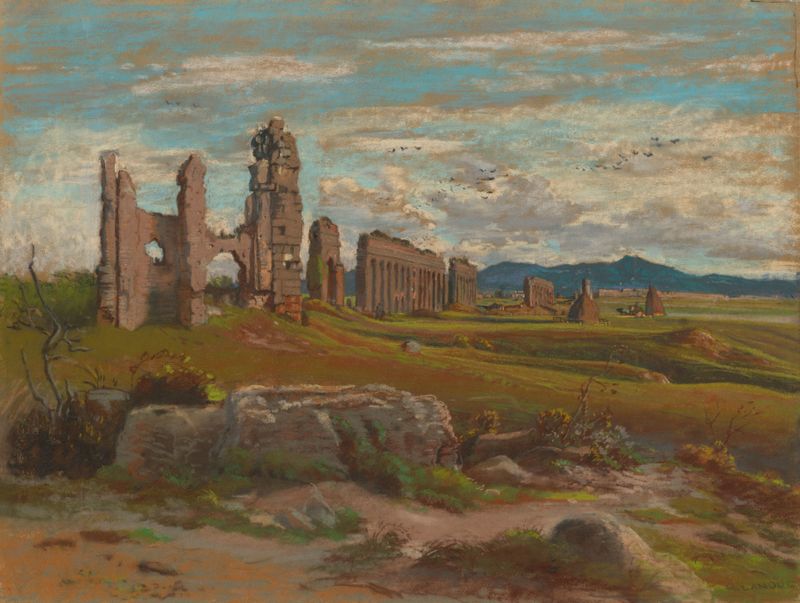
In the serene expanse of View of La Cava, the essence of transcendence emerges through a delicate interplay of hues and forms. The painting invites viewers to step into a world where nature speaks in whispers and the heart of the landscape pulses with life. Focus on the soft gradient of the sky, where violet and gold blend seamlessly at the horizon, drawing the gaze upward. Notice how the verdant hills roll gently in the foreground, their rich greens contrasting with the warm tones of the sunlit fields.
The meticulous brushwork captures the play of light across the landscape, creating a sense of depth that beckons exploration. Each element harmonizes, inviting the observer to linger in the moment captured — a fleeting glimpse of beauty and tranquility. Beneath its picturesque surface, the painting resonates with themes of solitude and reflection. The solitary figure in the foreground, barely distinguishable among the foliage, embodies a quest for connection with nature, suggesting a deeper yearning for introspection.
The tranquil water below mirrors the sky's subtle colors, creating a circular dialogue between the elements, perhaps hinting at the eternal cycle of life. Here, the artist weaves a narrative of silent contemplation, urging us to pause and consider our own place within the larger tapestry. In the early 1840s, Félix-Hippolyte Lanoüe was exploring the themes of landscape painting while living in France, a time when Romanticism was blooming, and artists sought to connect emotionally with their subjects. During this period, Lanoüe drew inspiration from the natural beauty surrounding La Cava, reflecting both his artistic vision and the evolving values of his era.
The work encapsulates a moment of introspection in a world increasingly captivated by the sublime.