View of Lake Starnberg — History & Facts
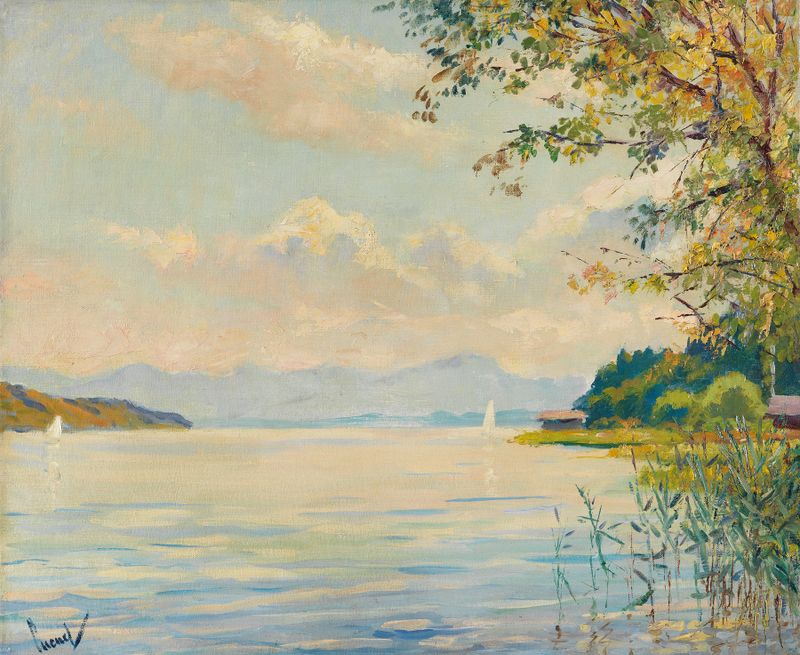
In the fleeting moments of life, truth often slips through our fingers, much like the shimmering reflections upon the surface of a lake. Here, the artist captures not just a landscape, but a profound meditation on memory and existence. Look to the center of View of Lake Starnberg, where soft ripples dance across the water, cradling the painted light that spills from the horizon. Notice how the sky, a delicate blend of pastel blues and warm golds, embraces the lake’s tranquil embrace.
The brushwork evokes a gentle breeze, suggesting movement while grounding the scene in stillness — a paradox that invites contemplation of nature’s eternal rhythm. Delve deeper into the contrast between the vividness of the foreground and the elusive quality of the background. The distant hills, rendered in muted tones, evoke a sense of longing, suggesting that memories are often as distant as they are vivid. Here, the tension between the clarity of the lake and the haziness of the horizon speaks of the duality of truth — it exists in moments, yet it is always receding, just out of reach. During the late 1920s, Edward Cucuel found himself captivated by the idyllic landscapes of southern Germany, particularly Lake Starnberg.
His work evolved amidst a world recovering from the aftermath of World War I, where artistic expressions sought to capture not just beauty, but a sense of peace and reflection. This artwork embodies that quest, blending impressionistic techniques with contemplative themes, as the artist navigated his own truths during a transformative era in art history.