
Vrouw op de dorpsweg — History & Facts
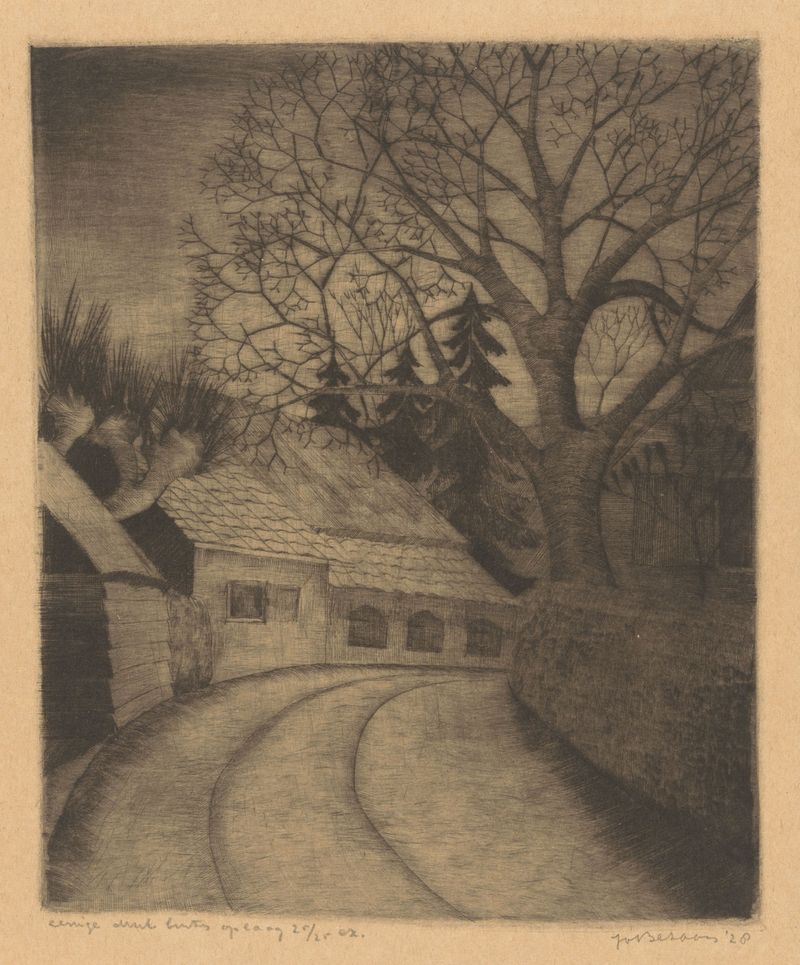
In a world where moments slip away like sand through fingers, the act of capturing desire becomes a powerful rebellion against the march of time. Look to the left at the solitary woman, her posture a mix of contemplation and yearning. Dressed in a soft, flowing garment that echoes the earthy hues of the path beneath her feet, she stands poised between the known and the unknown. Notice how the light gently bathes her figure, illuminating the contours of her face while casting deep shadows behind her — a dance of light that both highlights her presence and hints at the unseen depths of her thoughts. The subtle interplay of color reflects a world filled with longing.
The muted greens and browns of the landscape contrast sharply with the warmth of her attire, symbolizing the tension between her inner desires and the reality of her environment. Small details, like the delicate flutter of her skirt or the distant, faded figures in the background, suggest an intimacy with her surroundings as well as a potential yearning for something more, perhaps a life beyond the village road. In 1931, Jo Bezaan was navigating a post-war landscape, blending personal experiences with the broader shifts in society. Living and working in the Netherlands, he captured the essence of human emotion at a time when many were searching for stability and meaning.
This piece reflects not only his artistic evolution but also the collective desire for connection and hope in an ever-changing world.
More Artworks by Jo Bezaan
Browse all →
More Portrait Art
Browse all →
Las meninas
Diego Velázquez

Self-portrait with a Bandaged Ear and Pipe
Unidentified artist

Girl with a Pearl Earring
Johannes Vermeer

The Sampling Officials of the Amsterdam Drapers’ Guild, Known as ‘The Syndics’
Rembrandt van Rijn

The Hundred Guilder Print: the man seen on the back in the lower left corner
Rembrandt van Rijn

Portrait of Dr Gachet
Vincent van Gogh