
Vue d'Étaples — History & Facts
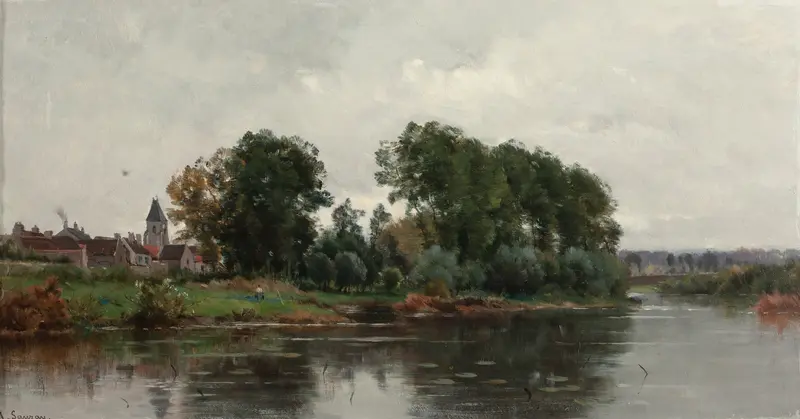
What first draws the eye in Vue d'Étaples is the vast, pale sky that seems to dwarf the clustered rooftops and masts along the horizon, as if the town itself is pausing for breath beneath the weight of open air. The painter, Adrien Jacques Sauzay, leads us along a winding ochre path that cuts through the foreground, a gentle invitation to wander toward the distant line of houses and boats. Each structure is rendered with a quiet solidity, their red-brown roofs and muted walls huddled together against the expanse.
The figures, scattered and small, signal daily life without drama—walking, pausing, perhaps exchanging a word—while the boats, with their angled masts, hint at the town’s connection to water and work. The low horizon grants the sky a commanding presence, filling the scene with a sense of calm and openness. Works like this, painted in the late nineteenth century, reflect the era’s fascination with the ordinary rhythms of rural and coastal communities. French artists of the period often traveled to small towns like Étaples, drawn by the changing light and the promise of scenes unspoiled by industry.
Such paintings were favored by collectors who sought reminders of a quieter France, and by artists eager to capture fleeting atmospheres. The documented date of this particular piece’s source—2014—reminds us how recently it has surfaced into public view, and how much of Sauzay’s quieter legacy remains scattered in private hands and lesser-known collections. To linger over this painting is to step into a world where the drama lies not in event, but in the subtle play of light and space.
More Artworks by Adrien Jacques Sauzay
More Landscape Art

The Starry Night
Vincent van Gogh

View of Delft
Johannes Vermeer

Water Lilies
Claude Monet

The Grand Canal, Venice, looking north-west from the Ca' Corner to the Ca' Contarini degli Scrigni, with the campanile of Santa Maria della Carità
Canaletto

Windsor Castle
Canaletto

The Grand Canal looking North-East from the Palazzo Dolfin-Manin to the Rialto Bridge
Canaletto