
Vue du château de Pau — History & Facts
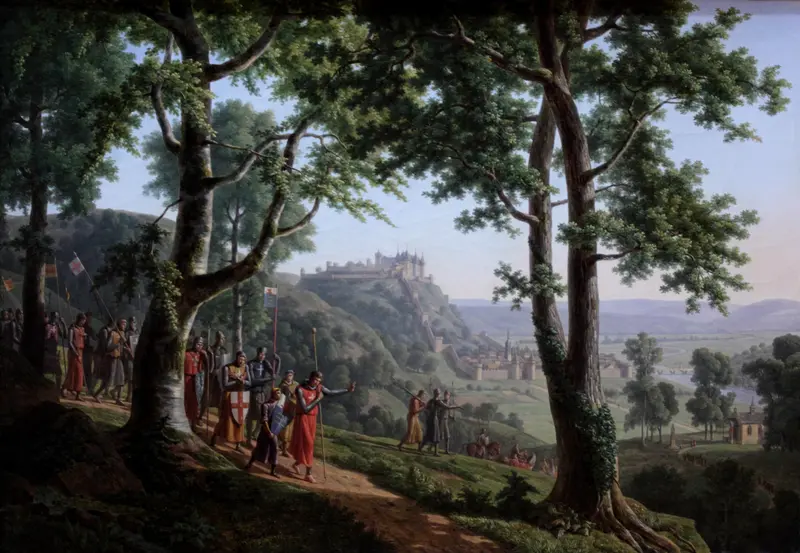
What first seizes the eye in Vue du château de Pau is the way the castle rises, almost dreamlike, from its wooded perch, framed by the grandeur of ancient trees and the sweep of a river below. Alexandre Louis Robert Millin du Perreux has chosen a vantage that invites the viewer to step into the scene, following the winding path from the shaded foreground, where a gathering of figures animates the landscape, toward the sunlit heights of the château itself. The play of light is deliberate: golden tones bathe the castle and the distant bridge, while the foreground remains cool and dappled, as if the drama of history is waiting just beyond the shadows.
The figures—some gesturing, others pausing in conversation—hint at a moment of arrival or departure, their presence lending the scene a sense of anticipation and ceremony. Painted in 1814, this work belongs to a moment when landscape painting was not merely a study of nature, but a statement of place and memory. The château de Pau, storied seat of the Béarn region and birthplace of Henri IV, was a potent symbol in the early nineteenth century, especially as France reckoned with its past and future after the Napoleonic era. Such views were often commissioned to celebrate heritage or commemorate visits, and artists like Millin du Perreux responded with carefully composed vistas that balanced topographical accuracy with theatrical staging.
Little is recorded about the subsequent journey of this particular painting, now preserved in a collection documented in 2018, but its quiet grandeur and layered storytelling invite the viewer to linger, searching for echoes of the lives and legends that once animated these grounds.
More Artworks by Alexandre Louis Robert Millin du Perreux
More Landscape Art

The Starry Night
Vincent van Gogh

View of Delft
Johannes Vermeer

Water Lilies
Claude Monet

The Grand Canal, Venice, looking north-west from the Ca' Corner to the Ca' Contarini degli Scrigni, with the campanile of Santa Maria della Carità
Canaletto

Windsor Castle
Canaletto

The Grand Canal looking North-East from the Palazzo Dolfin-Manin to the Rialto Bridge
Canaletto