
Vue du château et de la ville de Joinville — History & Facts
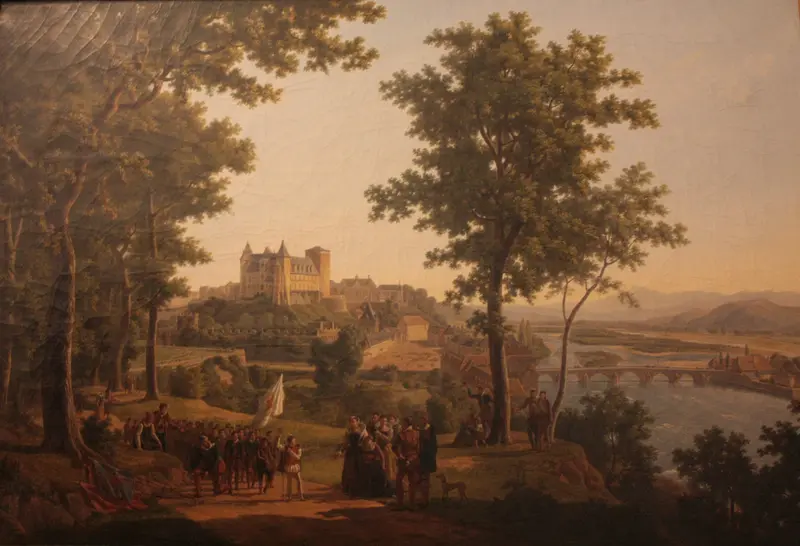
A procession winds its way through the filtered shade of ancient trees, the path alive with banners and armor, as if history itself is on the march. The artist draws the viewer into a world where the forest frames both the journey and its destination: the distant château, perched high and luminous on its promontory, dominating the valley below. Every gesture among the figures signals purpose and unity—one leader points the way, while others bear shields and standards, their faces set with resolve.
The light, cool and precise, guides the eye from the shadowed foreground up to the sunlit heights, inviting us to follow the pilgrims’ ascent and wonder at what awaits them beyond the gates. Painted in 1812, this scene belongs to the era when historical landscapes were charged with meaning, often commissioned to celebrate lineage, territory, or civic pride. Such works, blending topographical accuracy with narrative drama, were prized by local elites and collectors eager to anchor their identity in storied places. The artist, Alexandre Louis Robert Millin du Perreux, here crafts a vision that is both a document and a reverie, capturing the spirit of a time when the past was summoned to serve the present.
Now deposited in the FNAC collection and recorded in 2012, this painting stands as a rare survivor of its genre—history has kept few traces of its journey, but the vista it opens remains as compelling as ever.
More Artworks by Alexandre Louis Robert Millin du Perreux
More Landscape Art

The Starry Night
Vincent van Gogh

View of Delft
Johannes Vermeer

Water Lilies
Claude Monet

The Grand Canal, Venice, looking north-west from the Ca' Corner to the Ca' Contarini degli Scrigni, with the campanile of Santa Maria della Carità
Canaletto

Windsor Castle
Canaletto

The Grand Canal looking North-East from the Palazzo Dolfin-Manin to the Rialto Bridge
Canaletto