Warten auf den Zug — History & Facts
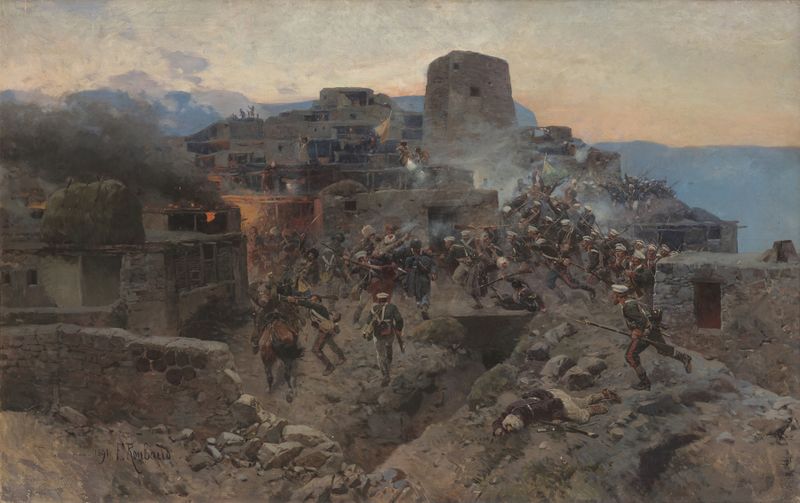
Can beauty exist without sorrow? In Warten auf den Zug, the tension between anticipation and despair unfolds, revealing the delicate balance of human emotion against the backdrop of history’s harsh realities. Focus on the figures to the left, where weary travelers huddle together, their faces a tapestry of hope and resignation. Notice the stark contrasts between the warm hues of the sunset that envelop them and the cooler tones creeping in from the shadows, hinting at an impending night. The train station, framed by the gathering dusk, is alive with an energy that both beckons and warns — a place where destinies converge, yet uncertainty looms like a heavy fog. The interplay of light and shadow in the artwork accentuates the underlying tension of waiting; it suggests that every moment holds a duality — the possibility of departure entwined with the fear of loss.
The details reveal the weight of history; the train, a symbol of progress, looms large, yet the figures’ expressions hint at untold stories of violence and disruption that accompany change. This juxtaposition forces the viewer to confront the fragility of hope amidst the inevitability of sorrow. Franz Roubaud painted this piece in 1882 while living in Russia, a time marked by dramatic social and political upheaval. As a celebrated artist known for his grand historical scenes, Roubaud found himself navigating an era fraught with tensions, where beauty often danced on the edge of darkness.
His work encapsulates not just the moment but the collective consciousness of a society on the brink of transformation.