
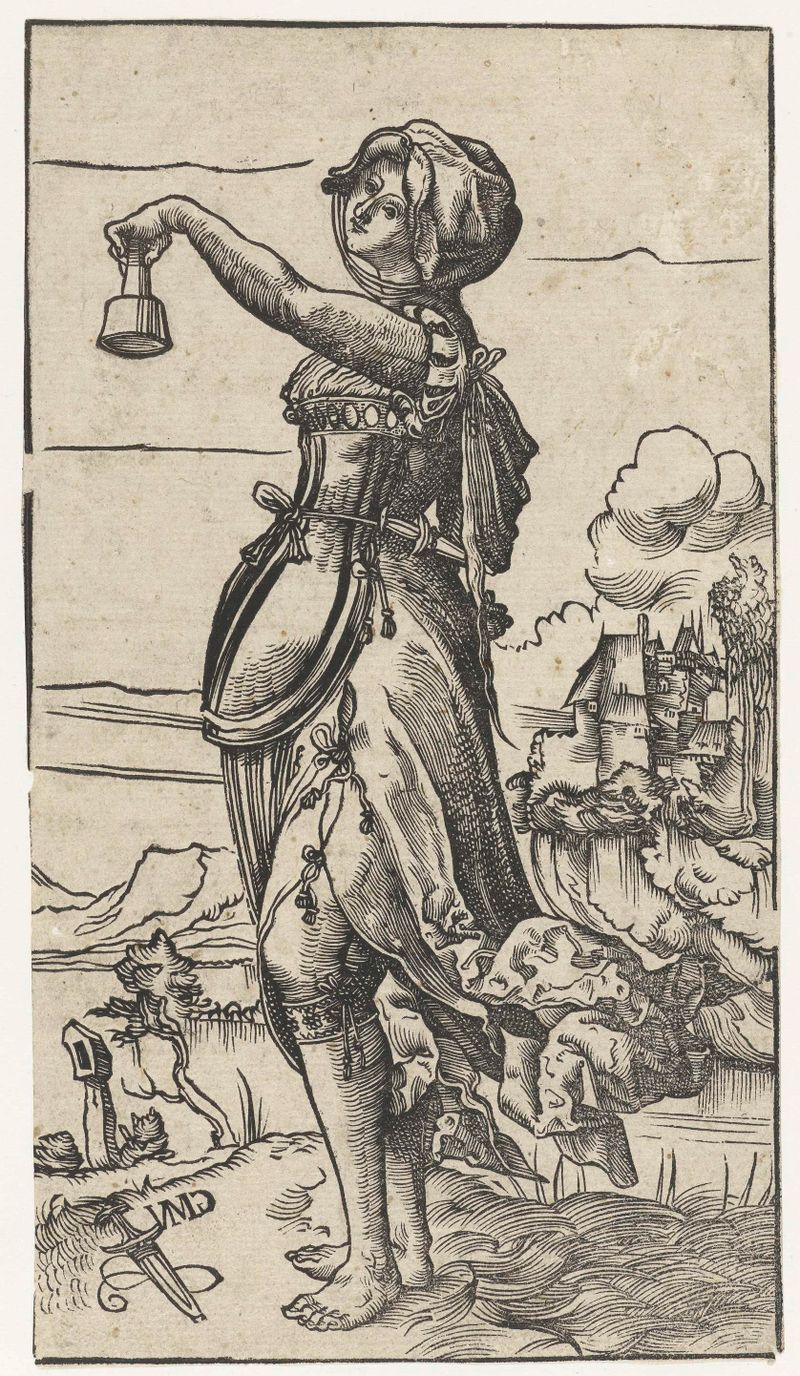
Wijze maagd met brandende olielamp in landschap — History & Facts
When did color learn to lie? In a world of painted truths, one must wonder whether the essence of perception can be manipulated. Focus on the figure at the center, a wise virgin holding a burning oil lamp. Notice how the warm glow of the lamp contrasts against the cool hues of the landscape, casting a halo of light that draws your eye. The vibrant greens and browns of the surrounding scenery breathe life into the scene, while the careful brushwork and meticulous details, especially in the foliage, evoke a vivid sense of realism.
The composition invites contemplation, with the gentle curvature of the landscape guiding you toward the figure's illuminating presence. Delve deeper into the painting's emotional landscape. The juxtaposition of the serene yet intense gaze of the virgin against the flickering flame suggests an inner tension—an obsession with knowledge and enlightenment amidst darkness. The lamp serves not merely as a source of light but as a symbol of wisdom, illuminating the path through ignorance, yet potentially consuming the bearer with its fire.
This duality reflects a profound commentary on the human condition, the pursuit of truth, and the shadowy corners of obsession. Niklaus Manuel Deutsch painted this work in 1518 during a period of significant cultural and artistic transition in Europe. It was a time when the Renaissance was redefining the boundaries of art, merging science and spirituality. Deutsch was deeply influenced by the humanist ideas of his contemporaries, which sought to explore the depths of human experience.
This painting exemplifies that exploration, revealing both the enlightenment and peril found in the quest for knowledge.
More Artworks by Niklaus Manuel Deutsch
Browse all →
More Religious Art
Browse all →
The Return of the Prodigal Son
Rembrandt van Rijn

The Garden of Earthly Delights
El Bosco

Count Orgaz’ funeral
El Greco

The Hundred Guilder Print: the central piece with Christ preaching, the plate arched
Rembrandt van Rijn

The Descent from the Cross
Rogier van der Weyden

The return of the prodigal son
Rembrandt van Rijn