Woman with a Parasol – Madame Monet and Her Son: meaning and location
From low on a hillside you look up at a woman in a pale dress, her moss-green parasol almost touching the top of the canvas, and at a small boy in grass up to his waist. Woman with a Parasol – Madame Monet and Her Son is Claude Monet’s (1840–1926) picture of his wife Camille and their son Jean. Painted outdoors in 1875 and shown a year later as Promenade (also called The Stroll), this Impressionist canvas has belonged to the National Gallery of Art in Washington since 1983.
- A low viewpoint: the museum’s description puts the viewer low on a hillside, looking up at the woman, who turns her head to look back at us. The boy seems to stand on the far side of the hill, with grass and flowers up to his waist.
- Sun, wind and colour: sunlight from behind Camille whitens the top of her parasol and the flowing cloth at her back, while reflections from the wildflowers touch her front with yellow. Long white strokes across her face suggest a veil fluttering in the breeze.
- A walk interrupted: Monet meant a casual family outing rather than a formal portrait, and used pose and placement to suggest that his wife and son paused while he painted them. The museum thinks he worked outdoors, probably in a single session of several hours.
- Shown as Promenade: the painting hung at the second Impressionist exhibition in Paris in 1876 (no. 161) under the title Promenade. The museum says its spontaneity and naturalness were praised there.
- Signature and size: signed at lower right, “Claude Monet 75”. Oil on canvas, 100 × 81 cm without the frame.
Sources: National Gallery of Art: collection record 1983.1.29 · National Gallery of Art open data (CC0), export of 14 November 2026: object 61379 · National Gallery of Art text on Google Arts & Culture (CC0 rights) · Wikidata Q2395218
Questions and answers about the painting
What is the meaning of Woman with a Parasol – Madame Monet and Her Son?
Monet set out to paint an ordinary family walk, not a formal portrait. The National Gallery of Art says Monet wanted the feeling of a casual outing and used pose and placement to suggest that his wife and son had paused while he painted them. The brevity of that moment is carried by animated brushstrokes of vibrant colour, and the spontaneity of the result was praised when the canvas was shown in 1876.
Source: National Gallery of Art text on Google Arts & Culture (CC0 rights) · National Gallery of Art: collection record 1983.1.29
Where is the painting by Claude Monet kept today?
In Gallery 85 of the West Building at the National Gallery of Art in Washington, D.C., according to the museum’s open data in November 2026 (accession 1983.1.29); displays change, so check before a visit. Monet sold the canvas in 1876 to Dr Georges de Bellio of Paris. After passing through the Donop de Monchy family and Georges Menier, it was bought for Paul Mellon at a Paris sale in 1965 and given to the gallery in 1983.
Source: National Gallery of Art open data (CC0), export of 14 November 2026: object 61379 · National Gallery of Art: collection record 1983.1.29 · National Gallery of Art text on Google Arts & Culture (CC0 rights)
Who are the woman and the boy in Claude Monet’s painting?
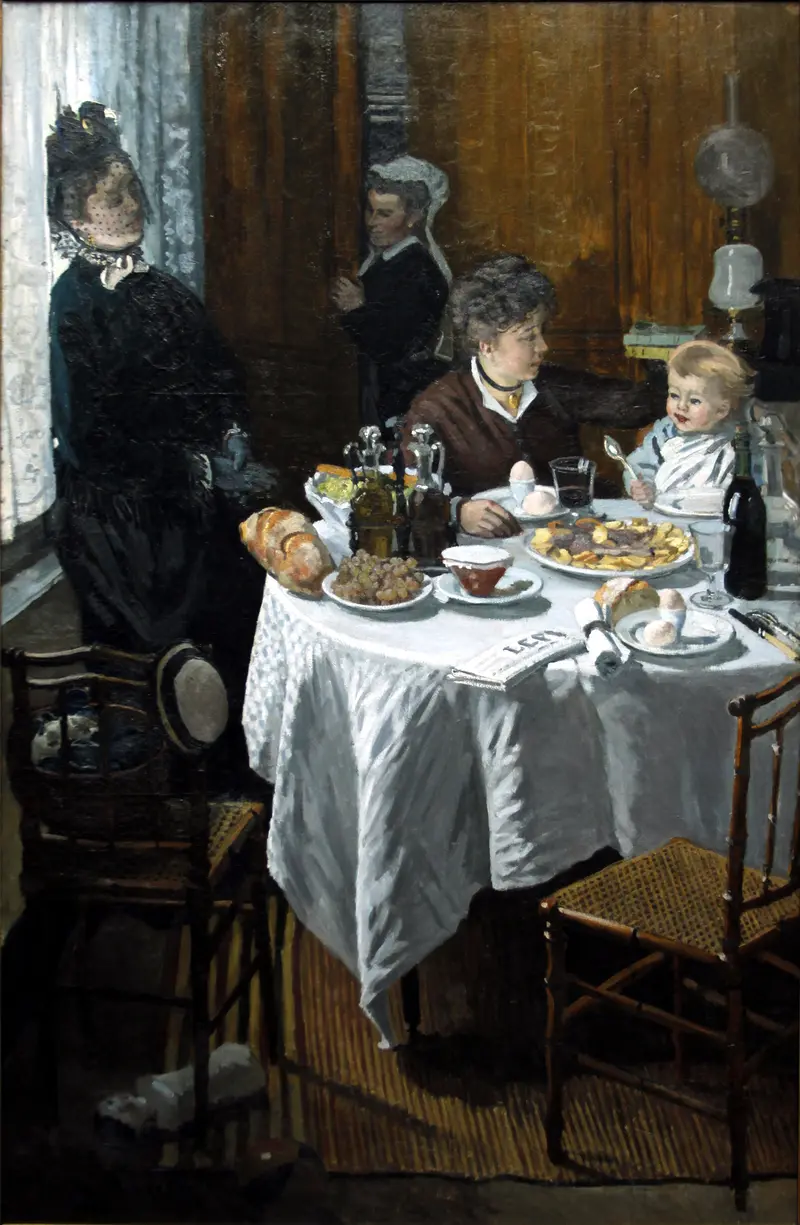
The woman is Camille Monet, the painter’s wife, and the boy is their son Jean. The museum’s title calls them Madame Monet and Her Son, and its subject keywords name Camille Monet and Jean Monet. Wikidata gives Camille Doncieux’s years as 1847–1879 and Jean’s as 1867–1914. The gallery adds that pose and placement suggest the two had interrupted their stroll while Monet captured their likenesses. Wikidata also lists Camille in Women in the Garden and La Japonaise, and mother and son together in The Poppy Field near Argenteuil and The Luncheon.
Source: National Gallery of Art open data (CC0), export of 14 November 2026: object 61379 · Wikidata Q2641426 (Camille Doncieux, 1847–1879) · Wikidata Q10862805 (Jean Monet, 1867–1914) · National Gallery of Art text on Google Arts & Culture (CC0 rights)
How big is the 1875 canvas by Monet?
Woman with a Parasol – Madame Monet and Her Son measures 100 × 81 cm (39 3/8 × 31 7/8 in.) without its frame and 119.4 × 99.7 cm (47 × 39 1/4 in.) framed. It is oil on canvas, and in this upright format the moss-green parasol almost touches the top edge. Monet signed it at lower right, “Claude Monet 75”.
Source: National Gallery of Art open data (CC0), export of 14 November 2026: object 61379 · National Gallery of Art: collection record 1983.1.29 · National Gallery of Art text on Google Arts & Culture (CC0 rights)
How does this painting differ from Monet’s 1886 Woman with a Parasol in Paris?
Count the figures and check the size. The 1875 painting in Washington shows a woman and a boy and measures 100 × 81 cm. The two 1886 canvases in the Musée d’Orsay, facing left (RF 2621) and right (RF 2620), measure about 131 × 88 cm and show the model Suzanne Hoschedé without a child. They are separate paintings by Monet, not copies of this one.
Source: Wikidata Q2395218 · Wikidata Q1451508 (Musée d’Orsay, RF 2621) · Wikidata Q2385427 (Musée d’Orsay, RF 2620) · National Gallery of Art open data (CC0), export of 14 November 2026: object 61379
Is the painting in the public domain?
Yes. Monet died in 1926, so his paintings are free of copyright in every country where protection lasts the author’s life plus 80 years or less. A faithful photograph of a public-domain painting adds no new copyright in the United States or the European Union, so you can download this image and use it in personal or commercial projects. Public Domain Images for Commercial Use explains how.
Source: Wikidata Q296 (Claude Monet, died 5 December 1926) · Wikidata Q2395218
More Artworks by Claude Monet
Grainstack (Sunset)
Claude Monet
Impression, Sunrise
Claude Monet
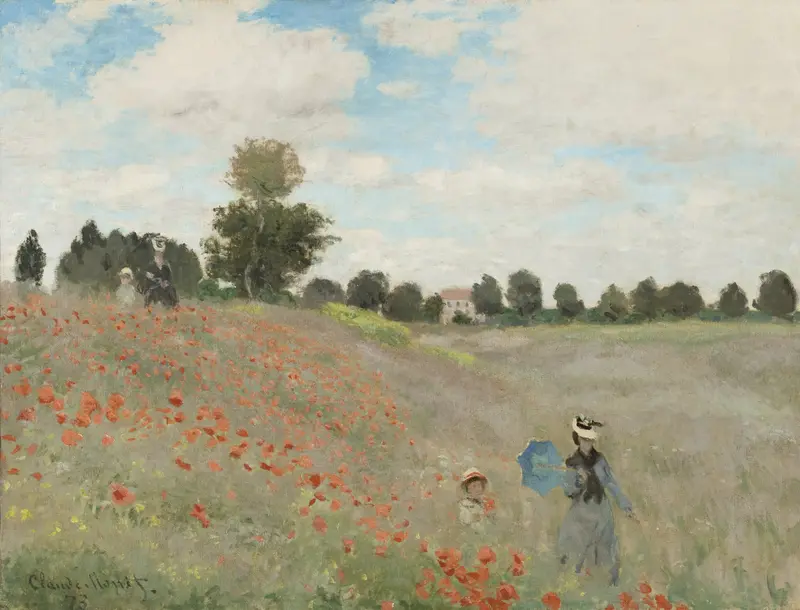
The Poppy Field near Argenteuil
Claude Monet
The Artist's Garden at Giverny
Claude Monet
The Luncheon
Claude Monet

The Gare Saint-Lazare
Claude Monet
Bathers at La Grenouillère
Claude Monet
The Magpie
Claude Monet

Water Lilies
Claude Monet
Women in the Garden
Claude Monet