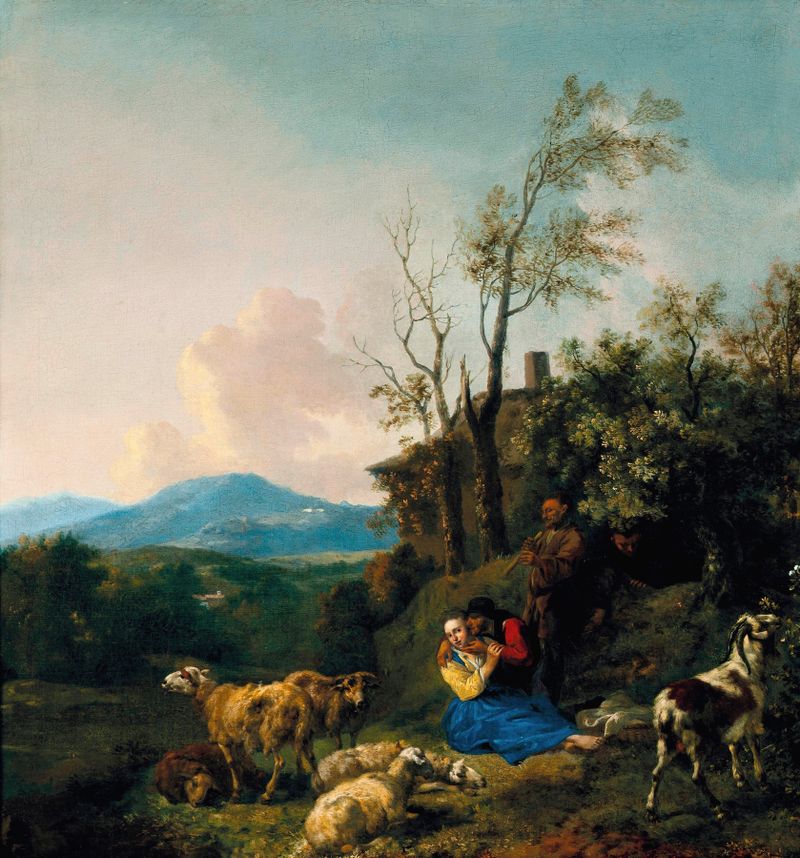
Woman with sheep at the ruins of the gatehouse of Brederode castle — History & Facts
Could beauty survive in a century of chaos? The delicate portrayal of a woman with sheep, set against the remnants of the gatehouse of Brederode Castle, whispers a fragile truth about resilience and solitude. Look closely at the foreground, where the woman stands serenely, her soft, flowing gown contrasting the weathered stones behind her. Notice how the muted palette of earth tones envelops the scene, with hints of green in the grass and the white fleeces of the sheep providing a gentle balance. The light bathes her figure in a warm glow, invoking a sense of peace amid the starkness of decay.
The ruins loom behind her, their grandeur diminished yet still majestic, symbolizing the passage of time. In this juxtaposition, there lies a profound tension. The woman, though graceful and composed, holds an air of melancholy, as if she embodies both the beauty and the fragility of existence amidst a backdrop of destruction. The sheep, often symbols of innocence and pastoral life, graze quietly, anchoring the scene in a moment of calm that contrasts sharply with the crumbling remnants of human ambition.
Together, they reflect the vulnerability inherent in beauty, suggesting that even in decay, there is a lingering grace. Jan Baptist Wolfaerts painted this scene in 1652 during a period when the Netherlands was grappling with political and social turbulence. Emerging from the shadows of conflict, artists like him sought to capture moments of quiet beauty amidst chaos, reflecting both personal and collective histories. Wolfaerts’ works often highlight the interplay between nature and human endeavors, reminding us of the fragility that persists even in the face of ruin.