
A Factory on Jawa — History & Facts
Did the painter know this moment would outlive them? In A Factory on Jawa, emptiness resonates through the bustling façade of industry, whispering of lives caught in the relentless machinery of progress. Focus on the foreground where the craggy silhouettes of factory buildings loom, their angular forms stark against the muted sky. Notice how muted greens and browns wash over the scene, creating a sense of desolation. The light struggles to break through the heavy clouds, casting an eerie glow that highlights the intricate details of the architecture while leaving the surrounding landscape in shadow.
This juxtaposition of light and dark embodies the tension between human endeavor and the vast emptiness of the natural world. As you explore the canvas, observe the subtle figures just outside the factory's imposing gates. They appear insignificant against the monumental backdrop, their presence hinting at the lives of workers engulfed in an impersonal system. The stark outlines of the structures emphasize the isolation felt amidst progress, drawing attention to the sometimes-forgotten human stories.
The silence of the scene speaks volumes, invoking a sense of loss and reflection on the cost of industrialization. H.Th. Hesselaar painted this work in 1851 during a transformative era for the Netherlands and the world, where the Industrial Revolution was reshaping economic landscapes. Living in a time of rapid change, the artist sought to capture not just the beauty of industry, but the underlying emptiness that accompanied it, marking a poignant moment in art history that questions the relationship between man and machine.
More Artworks by H.Th. Hesselaar
Browse all →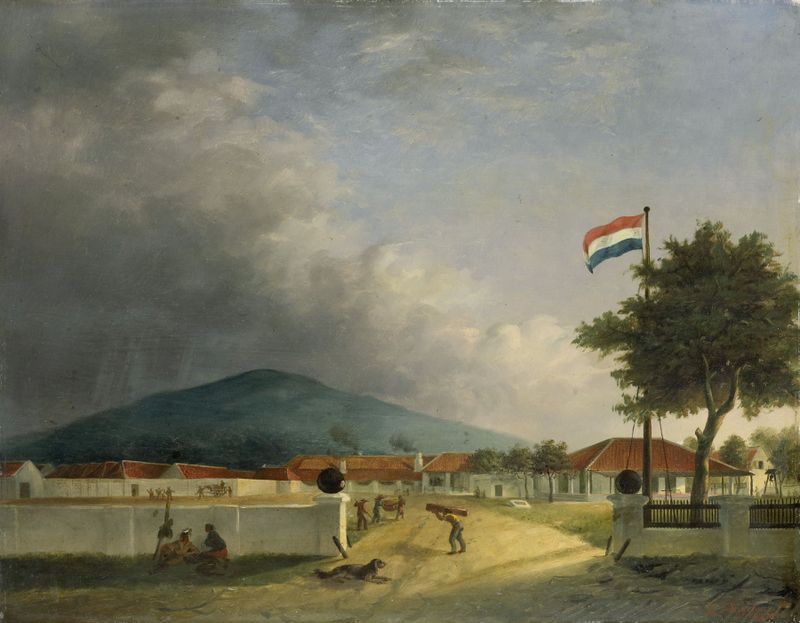


More Architecture Art
Browse all →
The statue of Liberty
Frédéric Auguste Bartholdi

View of Houses in Delft, Known as ‘The Little Street’
Johannes Vermeer

View of Houses in Delft, Known as ‘The Little Street’
Johannes Vermeer

The Cathedral in Rouen. The portal, Grey Weather
Claude Monet

The yellow house
Vincent van Gogh

The Church in Auvers-sur-Oise, View from the Chevet
Vincent van Gogh