American Ships Meet at Sea — History & Facts
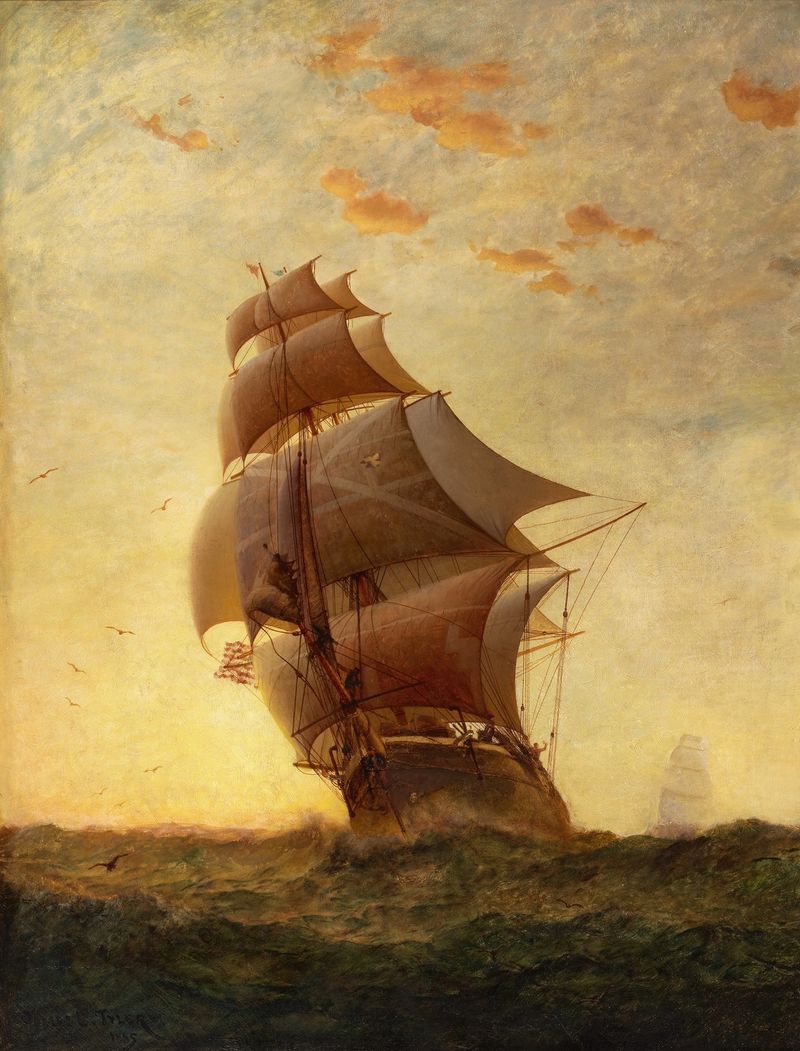
Where does light end, and longing begin? In the delicate interplay of sea and sky, the boundaries blur, inviting both the eye and heart to wander. Look to the horizon, where the warm glow of dusk spills over the silhouettes of two ships. Their sails, billowing gently, reflect the fading sunlight, each crease and fold captured with meticulous brushwork. The artist employs a palette of soft blues and golds that evoke a tranquil yet charged atmosphere, setting a stage where the sea meets the vastness of an endless sky.
Notice how the gentle waves undulate towards the viewer, their rhythmic movement guiding you into this maritime embrace. Yet beneath this serene surface lies an undercurrent of yearning. The ships, while in proximity, seem separated by an invisible barrier, hinting at both connection and distance. Each vessel, though majestic, carries the weight of adventure and the longing for home—a duality embodied in their solitary presence against the engulfing ocean.
The light dancing on the water serves as a metaphor for the fleeting moments of connection in life, illuminating both the joy of journey and the ache of separation. Created in 1903, this artwork emerged at a time when America was grappling with its identity as a maritime nation. James Gale Tyler, a rising figure in the art world, painted this piece during his tenure in Massachusetts, where he sought to capture the essence of American maritime life. The turn of the century was marked by an increasing fascination with industry and exploration, reflecting the ambitions and uncertainties of a nation in transition, both on land and at sea.