Ansicht von Prag mit der Moldaubrücke (Karlsbrücke) — History & Facts
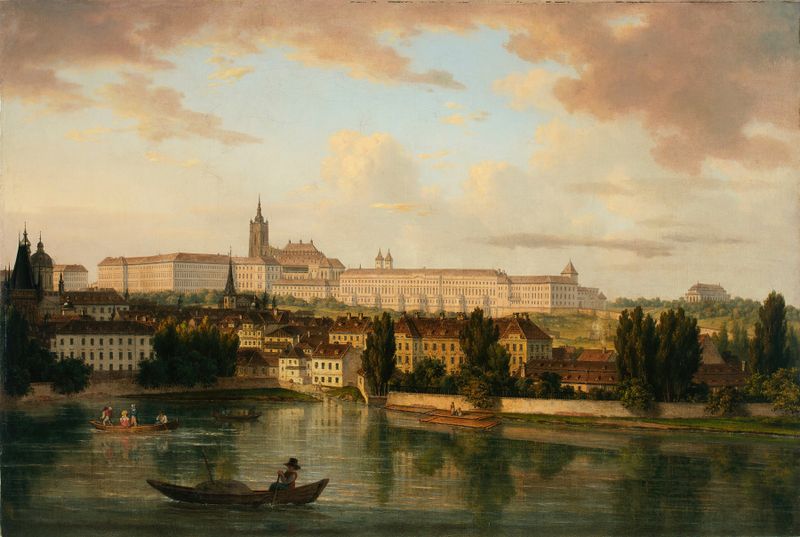
In the shadows of the past, we confront the delicate nature of existence, as fleeting as the fog that hugs the Prague skyline. Look to the left at the graceful arches of the Charles Bridge, their elegant silhouettes marking a pathway leading to the heart of the city. Notice how the muted palette of blues and grays invites a contemplative stillness, each brushstroke embodying a moment suspended in time. The composition draws the eye through a gentle curve, echoing the river’s flow, while wisps of soft light dance across the surface, hinting at the life teeming just below the façade of quietude. Yet, as the viewer is lured into this serene scene, deeper tensions reveal themselves.
The contrast between the solid stone of the bridge and the ephemeral mist serves as a poignant reminder of mortality—a world where permanence meets the ethereal. The solitary figures scattered along the bridge evoke a sense of introspection, their presence suggesting stories untold, weaving a tapestry of human experience against the backdrop of the eternal city. In 1831, Alois von Saar was immersed in a burgeoning Romantic movement, seeking to capture the essence of nature and the human spirit. Working in Prague, a city rich with history and culture, he painted Ansicht von Prag mit der Moldaubrücke during a time of shifting artistic paradigms, where the emphasis shifted away from neoclassical ideals towards more personal and emotional expressions.
This piece stands as a testament to that transition, inviting viewers to engage with the profound beauty and fragility of life itself.