
Ants Laikmaa. Taebla-Nomme TKM 0037A — History & Facts
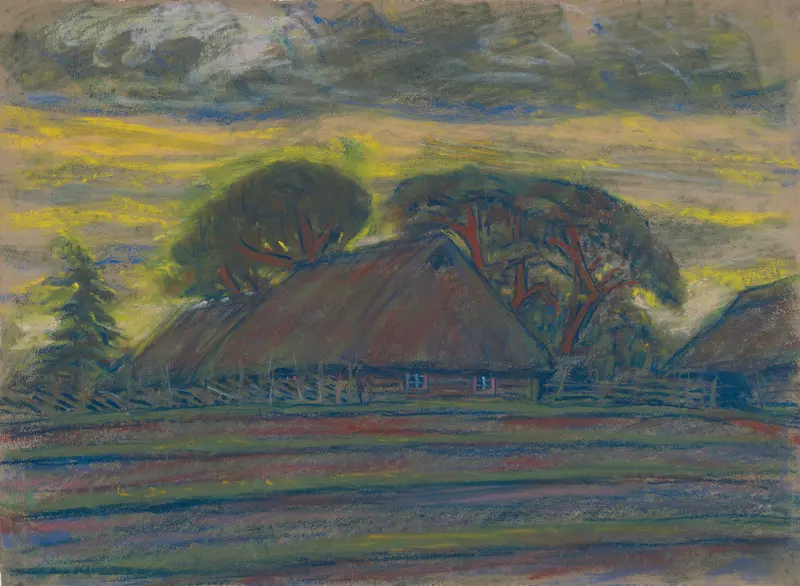
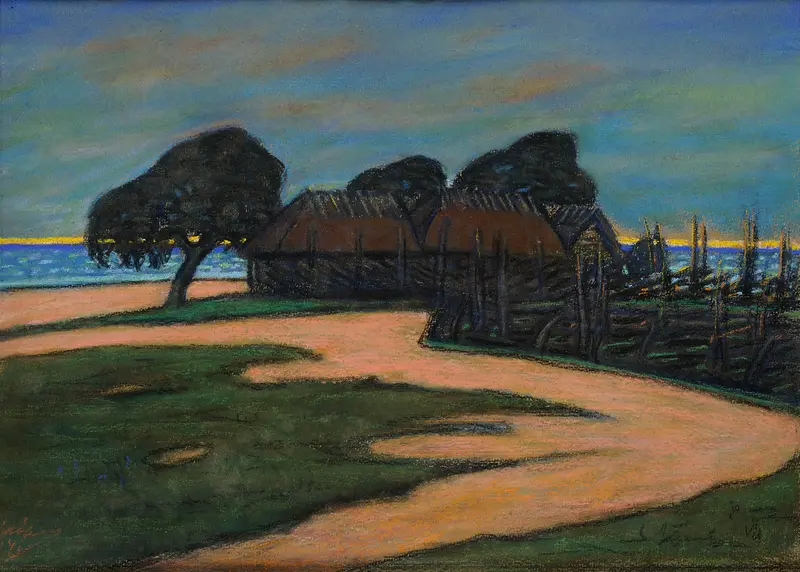
What draws the eye first in Taebla-Nomme is the way the sky presses down, heavy and restless, over the low thatched roofs and the dark, sheltering trees. The pastel’s strokes are broad and urgent, blurring the boundary between earth and sky, as if the landscape itself is breathing. The houses nestle deep in their setting, their small pink-framed windows catching the last of the light, while the trees rise behind them like silent guardians.
The yellow and green streaks across the horizon suggest a fleeting moment—perhaps dusk, perhaps dawn—when the air is charged with anticipation, and the world seems to hold its breath. Every element is fused by the artist’s hand into a single, pulsing mood: a quiet resilience, a sense of place that is both rooted and restless. Painted in 1918, this work belongs to a moment of great uncertainty in Estonia, as the old rural world met the shocks of modern history. Ants Laikmaa was known for his devotion to the Estonian landscape and people, often working in pastel to capture the fleeting effects of light and atmosphere.
Works like this were not grand commissions but personal meditations, shaped by the artist’s own travels and affections. Now held in the Tartu Art Museum, Taebla-Nomme stands as a record of a vanished countryside—one that history has only partly preserved, but which still asks us to linger in its twilight.
More Artworks by Ants Laikmaa
More Landscape Art

The Starry Night
Vincent van Gogh

View of Delft
Johannes Vermeer

Water Lilies
Claude Monet

The Grand Canal, Venice, looking north-west from the Ca' Corner to the Ca' Contarini degli Scrigni, with the campanile of Santa Maria della Carità
Canaletto

Windsor Castle
Canaletto

The Grand Canal looking North-East from the Palazzo Dolfin-Manin to the Rialto Bridge
Canaletto