Architectural capriccio with figures — History & Facts
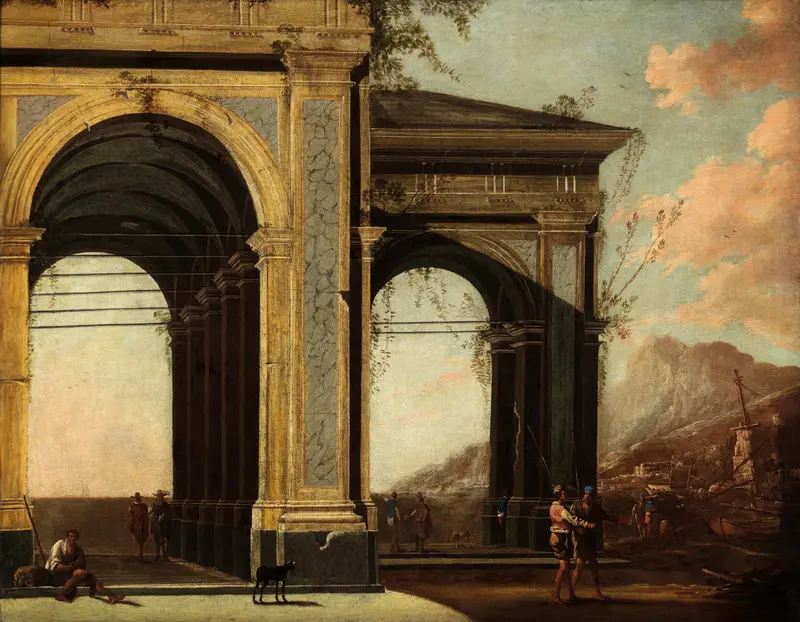
A sky heavy with drama draws the eye first, its restless clouds pressing down on a stage of imagined antiquity. Beneath this ceiling of light and shadow, the architecture commands attention—columns and arches that never stood in any real city, but rise here as a fantasy of ancient grandeur. Figures scatter across the scene, caught mid-gesture: a man gestures urgently with his staff, another slouches in the foreground, while groups gather and disperse along the steps and under the portico.
The light, angled and insistent, carves deep shadows and picks out the classical details, guiding us from the distant hills to the marble façade and the animated crowd. The mood is unsettled, as if something momentous has just happened or is about to, but the painter withholds the story, leaving us to search the faces and postures for clues. Works like Architectural capriccio with figures by Ascanio Luciani belong to a tradition that flourished in seventeenth-century Italy, where artists conjured up scenes of grand, imaginary ruins or palaces peopled with lively figures. These paintings were not mere exercises in fantasy; they spoke to the tastes of collectors who prized the learned play between past and present, reality and invention.
Painted sometime between 1641 and 1706, as documented by its source, this work reflects the era’s fascination with antiquity and the theatrical possibilities of architecture. History has kept few traces of Luciani himself, but in this painting, the ambitions of his age are written in stone and shadow—inviting us to step into a world that never was, but always feels just within reach.